Angles in Parallel Lines Worksheet Generator
Make printable angle practice with diagrams drawn to size – parallel lines cut by a transversal, angle pairs and triangles – with the relationship named in the key.
Recent
Your last 10 settings, saved only in this browser. Nothing is uploaded.
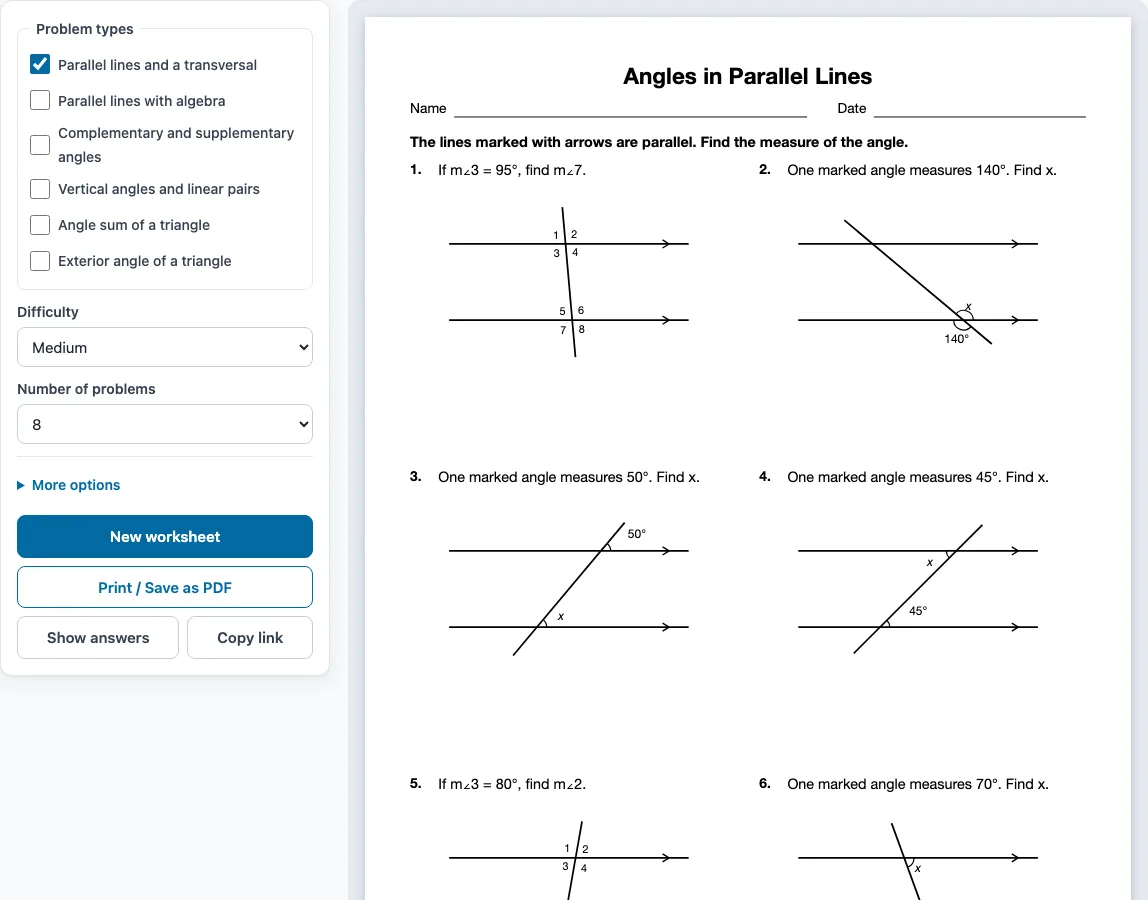
How to use the Angles Worksheet Generator
- Under Problem types, tick one or more boxes. “Parallel lines and a transversal” is ticked when the page opens. If you tick several types, the problems are shared out evenly between them and grouped by type, each group with its own instruction.
- Under Difficulty, choose Easy, Medium or Hard.
- Under Number of problems, choose 6, 8, 10, 12, 15, 20, 24 or 30.
- Open More options to set the Columns (Automatic, 1, 2 or 3), the Paper size (Letter 8.5 × 11 in or A4 210 × 297 mm), a Worksheet title, and the Name and date line checkbox.
- Check the preview on the right. It shows the sheet as it will print.
- Click New worksheet to get a fresh random set with the same settings.
- Click Print / Save as PDF. In the browser’s print dialog, choose “Save as PDF” if you want a file instead of paper.
Press Show answers to display each answer under its problem in the preview. Press it again to hide them. Copy link copies a link that opens exactly the same worksheet later, because the problem set is stored in the link as a number. Your settings are remembered in this browser for your next visit, unless you open a shared link, which uses that link’s settings. The generator also works on phones and tablets, though printing needs a printer or “Save as PDF.”
Angles rules worksheet: corresponding, alternate and same-side angles
When a transversal (a line) crosses two parallel lines, it makes eight angles. Corresponding angles sit in the same position at each crossing (for example, both above their line and to the right of the transversal), and they are equal. Alternate interior angles lie between the parallel lines on opposite sides of the transversal, and they are equal too.
The main rules to remember are these:
- Corresponding angles are equal.
- Alternate interior angles are equal.
- Alternate exterior angles are equal.
- Same-side (consecutive) interior angles add to 180°, and so do same-side exterior angles.
- Vertical angles, opposite each other where two lines cross, are equal.
- A linear pair, side by side on a straight line, adds to 180°.
- The angles of a triangle add to 180°.
- An exterior angle of a triangle equals the sum of the two remote interior angles.
How do you solve for x with parallel lines?
First, name the relationship between the angle you are given and the angle with x. If the angles are equal, set their expressions equal. If they are same-side angles or a linear pair, add them and set the sum to 180°. Then solve the equation for x, and substitute x back to find each angle.
For example, take (4x + 8)° = (2x + 36)°. Subtract 2x from both sides to get 2x + 8 = 36, then subtract 8 to get 2x = 28, so x = 14. Each angle is 4(14) + 8 = 64°.
If a single marked angle is given, such as 85° with a linear pair next to it, subtract from 180°: 180° − 85° = 95°. If a same-side exterior angle is 125°, the angle with x is 180° − 125° = 55°. Always check that your answer is reasonable, and that the angles you found agree with the relationship you used.
Sample problems from this generator
- If m∠2 = 55°, find m∠7. Answer: m∠ 7 = 55°(alternate exterior angles)
- If m∠4 = 55°, find m∠1. Answer: m∠ 1 = 55°(vertical angles)
- One marked angle measures 65°. Find x. Answer: x = 115°(linear pair)
- One marked angle measures 70°. Find x. Answer: x = 70°(alternate exterior angles)
Frequently asked questions
What is the difference between complementary and supplementary angles?
Complementary angles add up to 90°, and supplementary angles add up to 180°. For example, a 30° angle has a complement of 60° and a supplement of 150°.
Is there an answer key?
Yes. The Answer key on a separate page checkbox is on by default. When you print, the key starts on a new page after the worksheet and lists every problem number with its answer. Answers name the rule used, such as “x = 120° (alternate interior angles).”
Can I get different problems with the same settings?
Yes. Each click on New worksheet gives a different set of problems, and no problem repeats on one sheet. Teachers can print several versions, for example one for each row of desks.
Are the diagrams drawn to the real angle sizes?
Yes. The diagrams are drawn with the actual angle measures, so you can compare angles by eye. You still need the rules to find the unknown values.
Can I make a worksheet on a phone or tablet?
Yes. The generator works on phones and tablets as well as computers. To print or save a PDF, you need a printer or the “Save as PDF” option in your browser.
Will my settings still be there next time?
They will, as long as you return to the page in the same browser. Settings are not kept if you open a shared link, because that link uses its own settings.
Can I put these angles worksheets in a workbook or a KDP book?
Yes. The worksheets and answer keys you generate are free for personal, classroom and commercial use, such as Teachers Pay Teachers products, Etsy listings or a printed workbook. You do not need to credit this site. You may not copy the generator itself and offer it as your own tool.
Related tools
- Pre-algebra worksheets: Use these to practise the arithmetic and basic equations that come before solving for x.
- Solving equations worksheets: Use these when you need more practice isolating x in equations like the angle expressions above.
- Pythagorean theorem worksheets: Use these after triangle angle work, when you move on to side lengths in right triangles.
- Transformations worksheets: Use these to practise moving, turning and reflecting shapes, which builds on the same geometry ideas.
- Slope worksheets: Use these to practise the slope of a line, which connects to parallel lines because parallel lines have equal slopes.
- Algebra worksheets: Visit the home page to find more practice sheets across algebra topics.
- Similar shapes worksheets: use these when equal angles are used to show that triangles are similar or congruent.
- Parallel and perpendicular lines worksheets: use these for parallel and perpendicular lines on the coordinate plane.