Distributive Property Worksheet Generator
Make printable distributive property practice – from 7(20 + 3) to combining like terms and solving equations like 3(x − 2) = 12 – with an answer key.
Recent
Your last 10 settings, saved only in this browser. Nothing is uploaded.
This free distributive property worksheet generator makes printable practice sheets right in your web browser, with no sign-up needed. You choose the problem types, difficulty and number of problems, and the tool builds a worksheet with an answer key that you can print or save as a PDF.
The sheets cover the distributive property with plain numbers, expanding expressions such as 6(x + 1), distributing variable terms, simplifying expressions by combining like terms, solving equations, and factoring out a greatest common factor. Problems are made on your own device, and nothing is uploaded. Use it as a distributive property worksheet with answers for class, homework or a Teachers Pay Teachers product, or tick two types for a combine like terms and distributive property worksheet. Students can practise on a phone or tablet, and teachers can make several versions of the same sheet by clicking for new problems.
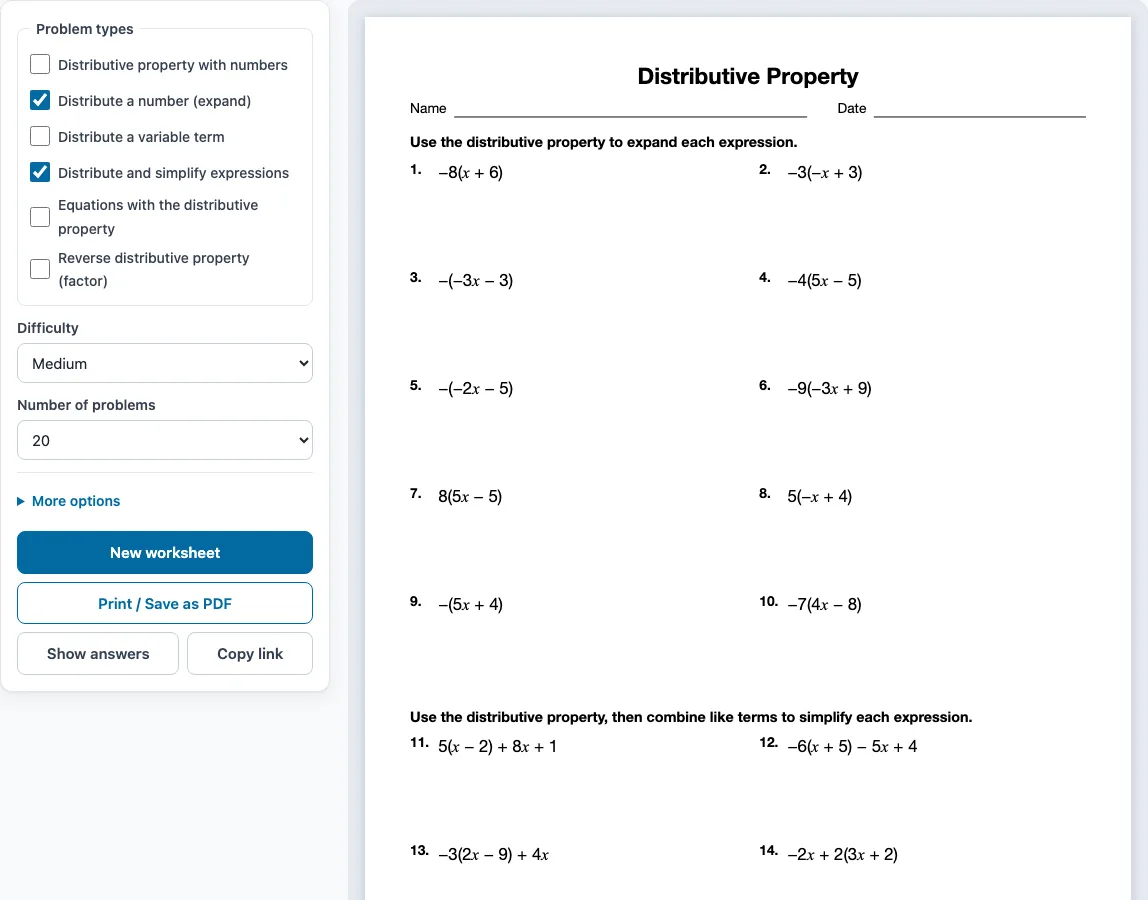
How to use the Distributive Property Worksheet Generator
- Tick one or more boxes under Problem types. When you tick several, the problems are shared evenly between them, and each group gets its own instruction line.
- Choose a Difficulty: Easy, Medium or Hard.
- Pick a Number of problems from 6, 8, 10, 12, 15, 20, 24 or 30.
- Open More options to set the Columns (Automatic, 1, 2 or 3), the Paper size (Letter 8.5 × 11 in or A4), a Worksheet title, and whether to show a Name and date line. Leave Answer key on a separate page ticked if you want the answers on their own page.
- Check the preview on the right. It shows the sheet as it will print.
- Click Show answers to check each answer on screen. Press it again to hide them.
- Click New worksheet for a fresh random set of problems with the same settings.
- Click Print / Save as PDF. In the print dialog, choose Save as PDF if you want a file instead of paper.
Copy link copies a link that opens exactly the same worksheet again. Your settings are remembered in this browser for your next visit, but opening a shared link uses that link’s settings. Printing needs a printer or the Save as PDF option.
What is the distributive property
The distributive property says that multiplying a number by a sum gives the same result as multiplying the number by each term separately: a(b + c) = ab + ac. It works with subtraction too: a(b − c) = ab − ac. You multiply the number outside the parentheses by every term inside.
For example, 7(20 + 3) = 7(20) + 7(3) = 140 + 21 = 161. The same idea makes some mental maths quicker. To find 23 × 998, write 998 as 1000 − 2, so 23(1000 − 2) = 23000 − 46 = 22954.
A negative factor changes every sign inside the parentheses. So −(x − 4) = −x + 4, and −3(2x − 5) = −6x + 15. Check each term after you multiply, because the second sign is the one students most often miss.
How do you use the distributive property with variables?
The rule is the same when the factor outside is a variable term: multiply it by every term inside and add the exponents of matching variables. The Distribute a variable term type starts with x(2x + 3) = 2x² + 3x on Easy and goes up to problems such as 5x²(2x² − 2x − 1) = 10x⁴ − 10x³ − 5x² on Hard. Hard problems in the Distribute a number (expand) type also use fractions and decimals, for example (5/4)(8x − 4) = 10x − 5, chosen so that every coefficient comes out whole.
How do you combine like terms with the distributive property
Distribute first, then add the like terms. Like terms have the same variable with the same exponent, so 8x and −3x can be combined, but 8x and 4 cannot.
Take 4(2x − 1) − 3(x + 5). Distribute to get 8x − 4 − 3x − 15. Then combine the like terms to get 5x − 19.
The same steps solve equations. Distribute, combine, and then undo the operations until the variable is alone. For 3(x − 2) = 12, distribute to get 3x − 6 = 12, add 6 to both sides to get 3x = 18, and divide by 3 to get x = 6.
Factoring is the distributive property read in reverse. You take out the greatest common factor: 12x + 18 = 6(2x + 3). The Reverse distributive property (factor) type practises exactly this, and Hard problems include a variable factor, such as 3x² − 21x = 3x(x − 7).
Sample problems from this generator
- −8(−3x − 3) Answer: 24x + 24
- −(−3x − 9) Answer: 3x + 9
- −2(−x + 5) − 9x + 3 Answer: −7x − 7
- −9 + x − 6(3x − 6) Answer: −17x + 27
Frequently asked questions
How do you solve equations with the distributive property?
Distribute the number outside each set of parentheses, combine like terms on each side, and then use inverse operations to isolate the variable. For example, 3(x − 2) = 12 becomes 3x − 6 = 12, and the solution is x = 6.
How do you handle negative numbers in distributive property problems?
Multiply the negative number by every term inside the parentheses, and remember that a negative times a negative is positive. For −2(−2x + 4), the terms become +4x and −8.
Can I sell these distributive property worksheets as a printable on Etsy or TpT?
Yes. Everything you make here is royalty-free for personal, classroom and commercial use, including Teachers Pay Teachers, Etsy printables, KDP workbooks and print-on-demand products. No credit is required. The only thing you may not do is copy the generator or the site itself to run a competing service. See the terms.
Are there free distributive property worksheets I can save as a PDF?
Yes. Make your worksheet, then click Print / Save as PDF and choose Save as PDF in the print dialog. There is no sign-up, and nothing is uploaded.
Can I get new problems with the same settings?
Yes. Click New worksheet for a fresh random set. No problem repeats on one sheet, so you can print several different versions for a class or practise again at home.
What does the answer key show?
When you print, the answer key starts on a new page after the worksheet. It lists every problem number with its answer: the expanded or simplified expression, the value of x, or the factored form.
Related tools
- Algebraic expressions worksheets: Use these when you want more practice writing and simplifying expressions before or after the distributive property.
- Solving equations worksheets: Use these to practise the equation steps once you can distribute and combine terms.
- Pre-algebra worksheets: Use these for a broader set of topics that come before algebra.
- GCF and LCM worksheets: Use these to practise finding the greatest common factor, which you need for factoring.
- Polynomials worksheets: Use these when you are multiplying and simplifying longer polynomial expressions.
- Factoring worksheets: Use these to practise the distributive property in reverse.
- Order of operations worksheets: Use these to check that you apply operations in the right order when you simplify.
- Algebra worksheets: Use this page to browse all the worksheet generators on the site.