Linear Functions Word Problems and Functions Worksheet Generator
Make printable functions practice – linear function word problems, f(x) notation, domain and range, tables, composition and inverses – with an answer key.
Recent
Your last 10 settings, saved only in this browser. Nothing is uploaded.
How to use the Functions Worksheet Generator
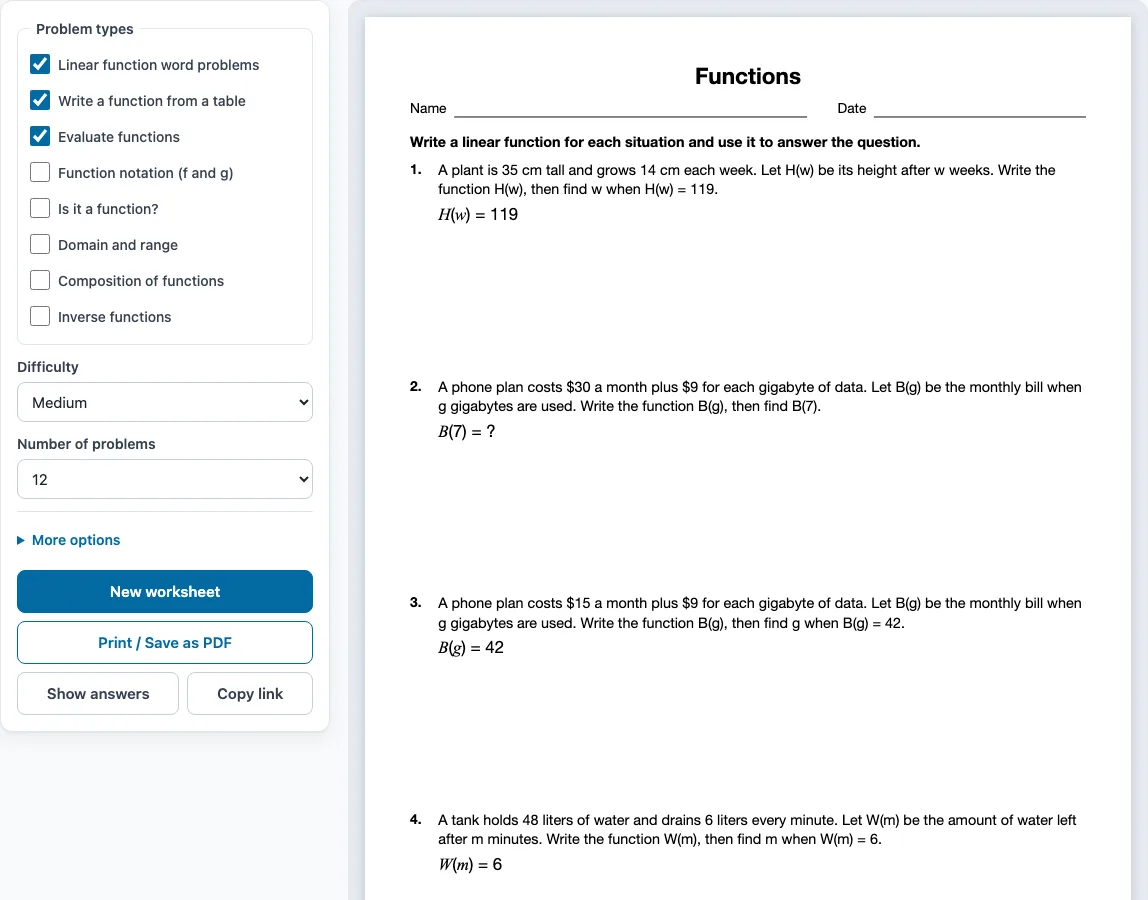
- Tick one or more boxes under Problem types. Tick Linear function word problems for this topic. If you tick several types, the problems are shared out evenly and grouped by type, each group with its own instruction.
- Choose a Difficulty: Easy, Medium or Hard.
- Choose the Number of problems: 6, 8, 10, 12, 15, 20, 24 or 30.
- Open More options to set the Columns (Automatic, 1, 2 or 3), the Paper size (Letter or A4), a Worksheet title, and whether to add a Name and date line.
- Check the preview on the right. It shows the sheet as it will print, with each group of problems under its own one-line instruction. Domain and range problems on Hard show a graphed segment on a small coordinate grid.
- Click Show answers to see the answers under each problem in the preview. Click again to hide them.
- Click New worksheet for a fresh random set with the same settings.
- Click Print / Save as PDF. In the print dialog, choose Save as PDF to create a file.
Your settings are remembered in this browser for your next visit, unless you open a shared link. To keep the exact same worksheet, click Copy link. The link stores the problem set as a number, so it opens the same problems again.
How do you write a linear function from a word problem
A linear function has the form f(x) = mx + b. It describes a situation where the output changes by the same amount for each unit of input. In a word problem, b is the starting amount or fixed fee (the value when x = 0), and m is the amount added per unit. The number m is also the slope, or rate of change.
To write the function, read the problem and find these two numbers. Then substitute the given input to answer the question. For example, a bike rental charges a $15 deposit plus $8 per day. If R(d) is the total cost after d days, then R(d) = 8d + 15. The cost for 2 days is R(2) = 8(2) + 15 = 31 dollars.
When the problem gives a table instead of words, use the steps between values. With equal steps in x, m = (change in y) ÷ (change in x). Then b is the y-value when x = 0. If the situation decreases, such as a tank draining, m is negative.
What is function notation
Function notation names a rule with a letter and shows the output for a given input. In f(x) = 3x + 6, f is the name of the function, x is the input, and f(x) is the output. The expression f(1) is read “f of 1.” Replace x with 1 to get f(1) = 3·1 + 6 = 9.
Function notation also lets you combine functions. The expression f(g(x)) means put g(x) into f. First find g(x), then use that result as the input for f. Evaluating a function means substituting a given input and simplifying. Problems that use two functions, such as f(1) + g(1), need you to evaluate each function separately and then combine the results.
Sample problems from this generator
- Sam has already read 25 pages of a book and reads 3 more pages each day. Let P(d) be the number of pages he has read after d days. Write the function P(d), then find d when P(d) = 37. P(d) = 37 Answer: P(d) = 3d + 25; d = 4days
- A gym charges a $30 joining fee plus $14 per month. Let C(m) be the total cost after m months. Write the function C(m), then find m when C(m) = 58. C(m) = 58 Answer: C(m) = 14m + 30; m = 2months
- x: −1, 1, 3, 5 f(x): 5, 11, 17, 23 Answer: f(x) = 3x + 8
- h(x) = −5x − 9, h(−3) Answer: h(−3) = 6
Frequently asked questions
How do you find the domain and range?
The domain is the set of inputs (x-values), and the range is the set of outputs (y-values). For a list of ordered pairs, list each distinct x-value for the domain and each distinct y-value for the range, without repeating any value. For a graphed segment, write them as inequalities, such as −2 ≤ x ≤ 4.
How do you tell if a relation is a function?
A relation is a function when each input gives exactly one output. For ordered pairs, check that no x-value appears with two different y-values. For example, {(8, 6), (8, 9)} is not a function because 8 has two outputs. On a graph, use the vertical line test: if any vertical line crosses the graph more than once, it is not a function.
Is there an answer key?
Yes. The option “Answer key on a separate page” is on by default. When you print, the key starts on a new page after the worksheet and lists every problem number with its answer.
Can I get a new set of problems with the same settings?
Yes. Click New worksheet to get a fresh random set with the same problem types, difficulty, and number of problems. No problem repeats on one sheet. Teachers can print several versions for different rows of desks, and students can practise again with new numbers.
Does it work on a phone or tablet?
Yes. It works on phones and tablets as well as computers. Printing needs a printer, or you can use Save as PDF to create a file.
Are these functions worksheets OK for Teachers Pay Teachers and Etsy?
Yes. The worksheets and answer keys you generate are free for personal, classroom and commercial use, such as Teachers Pay Teachers products, Etsy listings or a printed workbook. You do not need to credit this site. You may not copy the generator itself and offer it as your own tool.
Related tools
- Slope worksheets: Practise finding the rate of change (m) before you write functions from word problems.
- Equation word problems worksheets: Use these when you want more practice turning written situations into equations.
- Algebra 2 worksheets: Move on to the next level of function practice once linear functions feel comfortable.
- Systems of equations worksheets: Compare two linear models to find where they meet.
- Algebraic expressions worksheets: Review substituting values and simplifying before you evaluate functions.
- Algebra worksheets: Mix functions practice with equations, slope and factoring on one Algebra 1 sheet.
- Domain and range worksheets: use these for more domain and range practice from graphs, mapping diagrams and equations.
- Arithmetic sequence worksheets: use these to see sequences as functions of the term number.