GCF and LCM Worksheet Generator
Make printable GCF and LCM practice – plus prime factorization, prime or composite and divisibility rules – with an answer key on its own page.
Recent
Your last 10 settings, saved only in this browser. Nothing is uploaded.
This free GCF and LCM worksheet generator makes printable worksheets with an answer key, right in your web browser. There is no sign-up, and nothing is uploaded, because the problems are made on your own device.
You can create worksheets for the greatest common factor (GCF) and the least common multiple (LCM) of two or three numbers, or both together. It also makes prime factorization, prime or composite, divisibility rules, distributive property with the GCF, and GCF and LCM word problems. Outside the US the GCF is often called the HCF (highest common factor), so these also work as HCF worksheets; the LCM is also called the lowest common multiple, and the GCF the greatest common divisor. Everything you make here is free to use in class or in products you sell, such as Teachers Pay Teachers resources, Etsy printables or KDP workbooks.
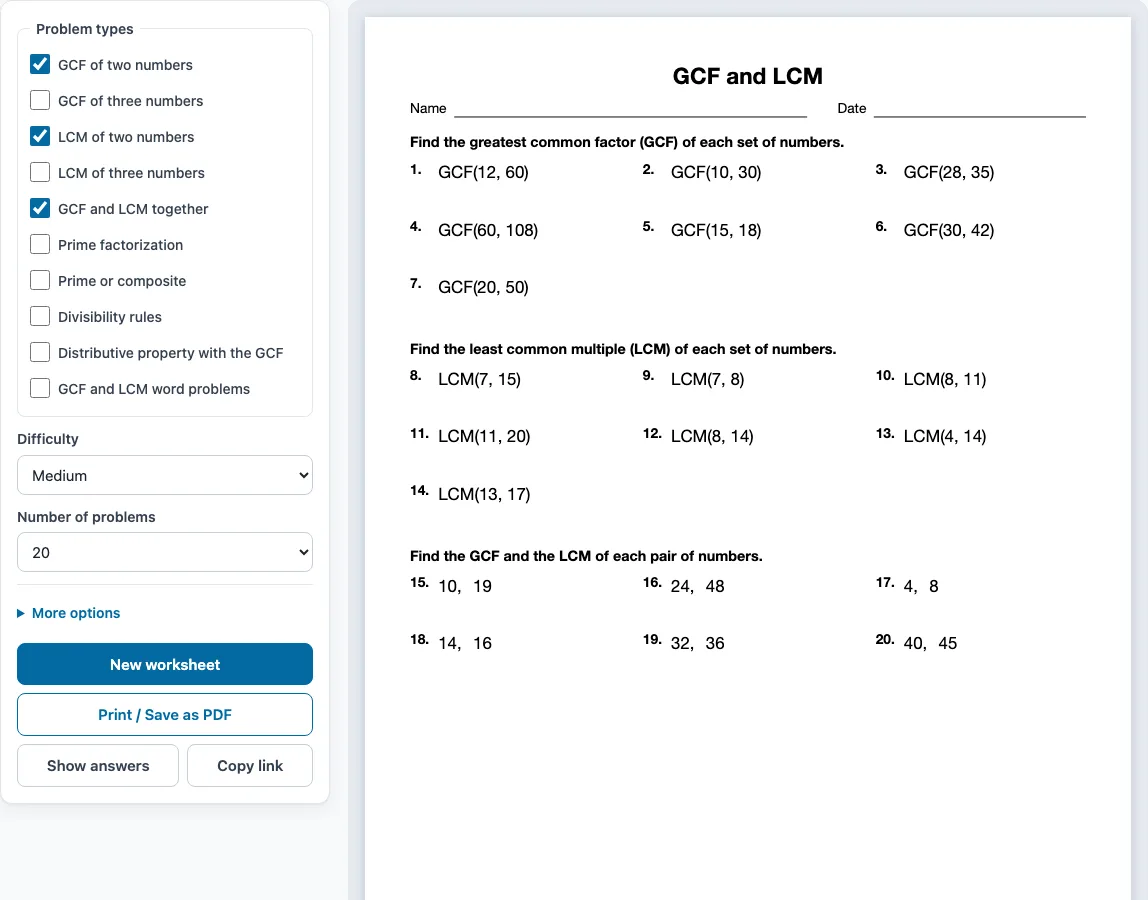
How to use the GCF and LCM worksheet generator
- Under Problem types, tick one or more boxes. GCF of two numbers, LCM of two numbers, and GCF and LCM together are ticked when the page opens.
- Under Difficulty, choose Easy, Medium or Hard.
- Under Number of problems, choose 6, 8, 10, 12, 15, 20, 24 or 30.
- Open More options if you want to change the layout. You can choose the Columns (Automatic, 1, 2 or 3), the Paper size (Letter or A4), a Worksheet title, and whether to show a Name and date line. The Answer key on a separate page box is on by default.
- Check the preview on the right. It shows the sheet as it will print.
- Press Show answers to see the answers under each problem in the preview. Press it again to hide them.
- Press Print / Save as PDF. In the print dialog, choose Save as PDF if you want a file instead of paper.
- Press New worksheet to get a fresh random set with the same settings.
If you tick several problem types, the problems are shared out evenly between them. Each group has its own instruction line, and the problems are numbered 1 to N across the sheet. No problem repeats on one sheet.
Your settings are saved in this browser for your next visit. To share the exact same worksheet, press Copy link. Anyone who opens that link gets the same problems and settings.
How do you find the GCF and LCM?
The most reliable method is prime factorization. Write each number as a product of prime numbers. For the GCF, take each prime that appears in every number, using the smallest power of that prime. For the LCM, take every prime that appears in any number, using the largest power.
For example, 24 = 2³ · 3 and 36 = 2² · 3². The shared primes are 2 and 3. The smallest power of 2 is 2², and the smallest power of 3 is 3¹, so GCF = 2² · 3 = 12. The largest powers are 2³ and 3², so LCM = 2³ · 3² = 72.
For two numbers, there is a useful check: GCF × LCM equals the product of the two numbers. Here, 12 × 72 = 864, and 24 × 36 = 864. The same method works for three numbers. For GCF(32, 40, 72), the only prime shared by all three is 2, and the smallest power is 2³, so the GCF is 8.
What is the difference between GCF and LCM?
The GCF is the largest number that divides evenly into each number in the set. The LCM is the smallest number that each number divides into evenly. In other words, the GCF is about factors, and the LCM is about multiples.
Because of this, the GCF is never larger than the smallest number, and the LCM is never smaller than the largest number. For 4 and 9, the only common factor is 1, so GCF = 1. Their smallest common multiple is 36, so LCM = 36. For 80 and 90, GCF = 10 and LCM = 720. 720 is a multiple of both numbers (80 × 9 and 90 × 8), and 10 is the largest number that divides both.
When do you use the GCF and when the LCM in word problems?
Use the GCF when a set of things is split into equal groups with nothing left over. In one problem from the generator, a teacher has 35 pencils and 28 erasers and wants identical supply kits; GCF(35, 28) = 7, so she can make 7 kits, each with 5 pencils and 4 erasers. Use the LCM when two repeating events have to line up again: if one bus leaves every 5 minutes and another every 8 minutes, both leave together again after LCM(5, 8) = 40 minutes. The answer key gives the number with its unit, such as 7 kits or 40 minutes.
Sample problems from this generator
- GCF(10, 20) Answer: 10
- GCF(15, 40) Answer: 5
- LCM(8, 20) Answer: 40
- 6, 24 Answer: GCF = 6 LCM = 24
Frequently asked questions
Is 1 a prime number?
No. A prime number has exactly two factors, 1 and itself. The number 1 has only one factor, so it is neither prime nor composite.
What is the difference between a prime and a composite number?
A prime number, such as 7, has exactly two factors. A composite number, such as 9, has more than two factors (9 has 1, 3 and 9). Prime factorization breaks a composite number into prime numbers only.
Does this tool include a rules of divisibility worksheet?
Yes. Choose the Divisibility rules problem type to get a worksheet that asks which of 2, 3, 4, 5, 6, 9 and 10 divide each number evenly. The rules are: a number is divisible by 2 if its last digit is even, by 3 if its digit sum is divisible by 3, by 4 if its last two digits are divisible by 4, by 5 if its last digit is 0 or 5, by 6 if it is divisible by both 2 and 3, by 9 if its digit sum is divisible by 9, and by 10 if its last digit is 0.
How do you know whether a word problem needs GCF or LCM?
Ask what the question is looking for. If it asks for the greatest number of equal groups, kits or square tiles, or the longest equal piece that fits, use the GCF. If it asks when two things will happen together again, or how often they repeat in sync, use the LCM.
Is a common multiple worksheet the same as a least common multiple worksheet?
Not exactly. A common multiple is any number that is a multiple of each number in the set, such as 72, 144 or 216 for 24 and 36. The least common multiple is the smallest of these, which is 72. The LCM problems on this tool ask for that smallest value.
Can I sell GCF and LCM worksheets made with this generator?
Yes. You can sell what you make here, for example as a Teachers Pay Teachers resource, an Etsy download or pages in a KDP book. It is royalty-free and needs no credit line. The only limit is that you may not mirror or resell the site or its generators as a competing service.
Related tools
- Factoring worksheets: Use these when you need to pull the greatest common factor out of algebra expressions.
- Rational expressions worksheets: Use these to practise finding the least common denominator when adding fractions with variables.
- Exponents worksheets: Use these to get comfortable with powers, which you need to read prime factorizations like 2³ · 3².
- Order of operations worksheets: Use these to practise the calculation order you need when you rewrite sums with the distributive property.
- Pre-algebra worksheets: Use these for a wider review of number topics before moving to algebra.