Order of Operations Worksheet Generator
Make printable PEMDAS practice – from easy two-step problems to brackets, exponents and fractions – with an answer key on its own page.
Recent
Your last 10 settings, saved only in this browser. Nothing is uploaded.
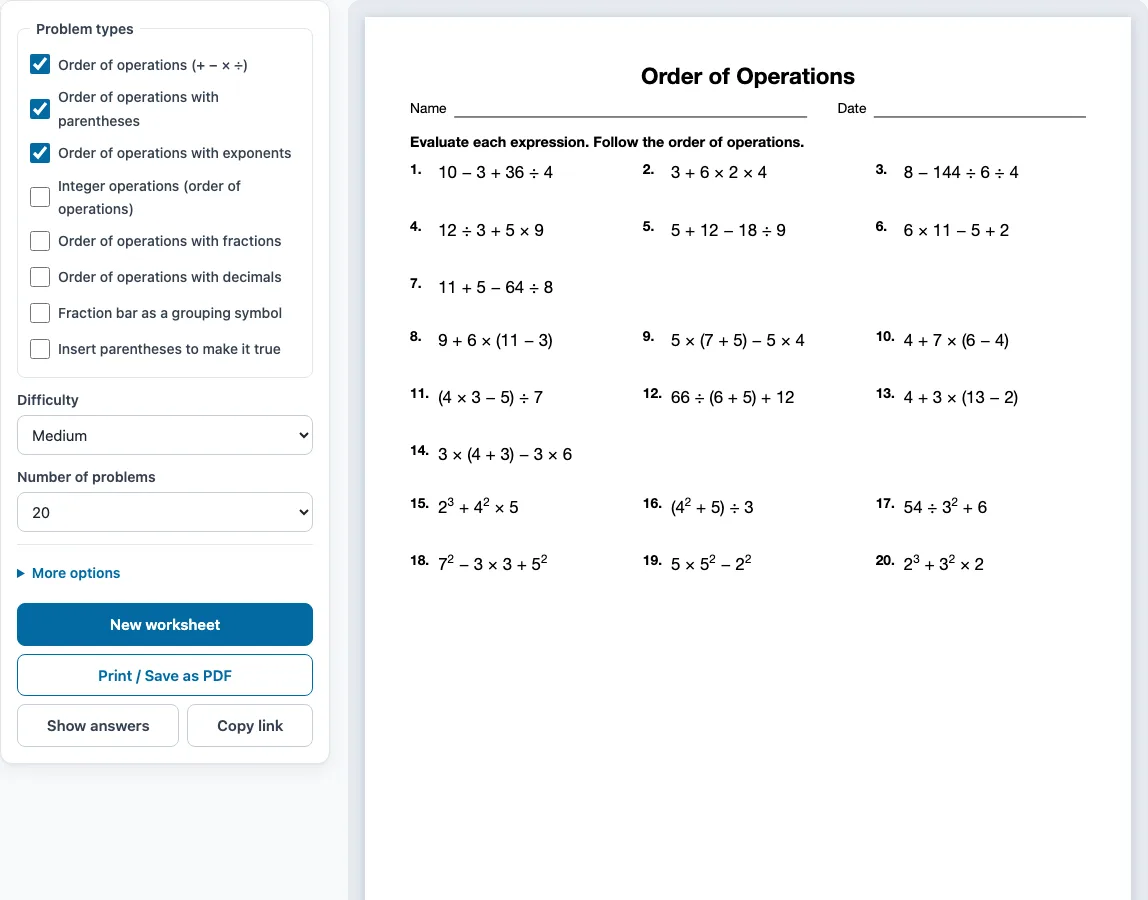
How to use the Order of Operations Worksheet Generator
- Tick one or more boxes under Problem types. The first three are ticked when the page opens: Order of operations (+ − × ÷), Order of operations with parentheses and Order of operations with exponents.
- Choose a Difficulty: Easy, Medium or Hard.
- Pick the Number of problems, from 6 up to 30. If you tick several types, the problems are shared evenly between them and each group gets its own instruction line.
- Open More options to set the Columns (Automatic, 1, 2 or 3), the Paper size (Letter or A4), a Worksheet title and, if you want one, the Name and date line.
- Check the preview on the right. It shows the sheet as it will print.
- Click Show answers to check your work on screen. Click it again to hide the answers.
- Click New worksheet for a fresh set of problems with the same settings.
- Click Print / Save as PDF. In the print dialog, choose Save as PDF to create a file.
Your settings are remembered in this browser for your next visit. Click Copy link to copy a link that reopens exactly the same worksheet, which is useful for sending a set to a student. Teachers can click New worksheet several times to print different versions for different groups of desks.
What is the order of operations (PEMDAS)?
The order of operations is the agreed sequence for working out a calculation that has more than one step, so that everyone gets the same answer. In the United States it is remembered as PEMDAS: Parentheses, Exponents, Multiplication and Division, Addition and Subtraction. In the UK it is taught as BODMAS or BIDMAS, which mean the same thing: Brackets, Orders (or Indices), Division and Multiplication, Addition and Subtraction.
Work through the groups in this order. Here is a worked example:
6 + 2 × 3² = 6 + 2 × 9 = 6 + 18 = 24
Start with the exponent (3² = 9), then multiply, then add. When brackets are nested, work from the innermost group outward:
43 − [6 + 6 × (7 − 2)] = 43 − [6 + 30] = 7
A fraction bar also groups its top and bottom. Simplify each part first, then divide. The sign matters too: −6² means −(6²) = −36, while (−6)² = 36.
Do you multiply before you divide?
Not always. Multiplication and division have equal rank, so you work from left to right, doing whichever comes first. Addition and subtraction work the same way.
For example, in 20 ÷ 4 × 5, the division comes first because it is on the left: 20 ÷ 4 = 5, then 5 × 5 = 25. Dividing 4 × 5 first would give the wrong answer of 1.
Here is a mixed example from the tool’s Medium level:
12 + 12 × 6 ÷ 3 = 12 + 72 ÷ 3 = 12 + 24 = 36
The multiplication and division are done left to right, and the addition is last. The letters in PEMDAS and BIDMAS are a memory aid, not a rule that multiplication always beats division.
How do fractions, fraction bars and missing parentheses change the order?
The rules stay the same with fractions: in 1/2 − (1/3)², square first to get 1/9, then subtract, so 1/2 − 1/9 = 9/18 − 2/18 = 7/18. With a fraction bar, finish the top and the bottom before dividing: (6 + 5 × 2) / (8 − 2 × 3) = 16 / 2 = 8.
The Insert parentheses type works backwards. The sheet shows a statement such as 9 × 8 + 7 = 135, which is false as written (72 + 7 = 79). Students try one pair of parentheses at a time until the value matches; 9 × (8 + 7) = 9 × 15 = 135. Each of these problems has exactly one placement that works, so the key shows that single answer.
Sample problems from this generator
- 12 ÷ 6 + 60 ÷ 5 Answer: 14
- 72 ÷ 6 ÷ 3 + 6 Answer: 10
- (9 + 3) × 6 − 10 Answer: 62
- (92 + 11) ÷ 2 Answer: 46
Frequently asked questions
Are there example PEMDAS problems I can check my work against?
Yes. The tool’s Easy level includes 5 × 3 − 2 = 13. The Medium level includes 12 + 12 × 6 ÷ 3 = 36, and the Hard level includes 13 × 8 − 18 × 5 ÷ 6 = 89. Work each one step by step, then compare with the answer.
Is there an order of operations cheat sheet I can print?
The short list is easy to keep handy. Write Parentheses, Exponents, Multiplication and Division, Addition and Subtraction on an index card, and add “left to right” under the last two. Keep the card beside you while you work the problems.
Can I make an easy order of operations worksheet for beginners?
Yes. Tick only Order of operations (+ − × ÷), set Difficulty to Easy and choose a small number of problems, such as 6 or 8. Beginners can then practise the basic steps before moving on to parentheses or exponents.
Are the answers whole numbers, or can they be decimals and fractions?
Every division on the sheets comes out exactly. Decimal answers are exact, and fraction answers are written in lowest terms. For fraction problems, the answer is a whole number or a fraction in simplest form.
Can I practise on my phone or tablet?
Yes. The generator works on phones and tablets as well as computers. You need a printer or the Save as PDF option to print a sheet, but you can still work through the problems on screen with Show answers.
Can I sell the order of operations worksheets I make here on Teachers Pay Teachers?
Yes. The worksheets and answer keys you generate are free for personal, classroom and commercial use, such as Teachers Pay Teachers products, Etsy listings or a printed workbook. You do not need to credit this site. You may not copy the generator itself and offer it as your own tool.
Related tools
- Integers worksheets: Use these when you want more practice with negative numbers before tackling integer order of operations.
- Exponents worksheets: Use these to build speed with powers and roots before combining them with other operations.
- Algebraic expressions worksheets: Use these once you can evaluate expressions and want to simplify expressions with letters.
- GCF and LCM worksheets: Use these to practise factors and multiples, which often appear alongside fraction work.
- Pre-algebra worksheets: Use these for a broader set of topics that build on order of operations.
- Percent worksheets: Use these to practise percentage calculations that require the same step-by-step thinking.
- Absolute value worksheets: Use these to practise the distance-from-zero rule that appears in integer problems.