Parallel and Perpendicular Lines Worksheet Generator
Make printable practice on parallel and perpendicular lines – compare slopes, classify pairs of lines and write the equation of a parallel or perpendicular line – with an answer key.
Recent
Your last 10 settings, saved only in this browser. Nothing is uploaded.
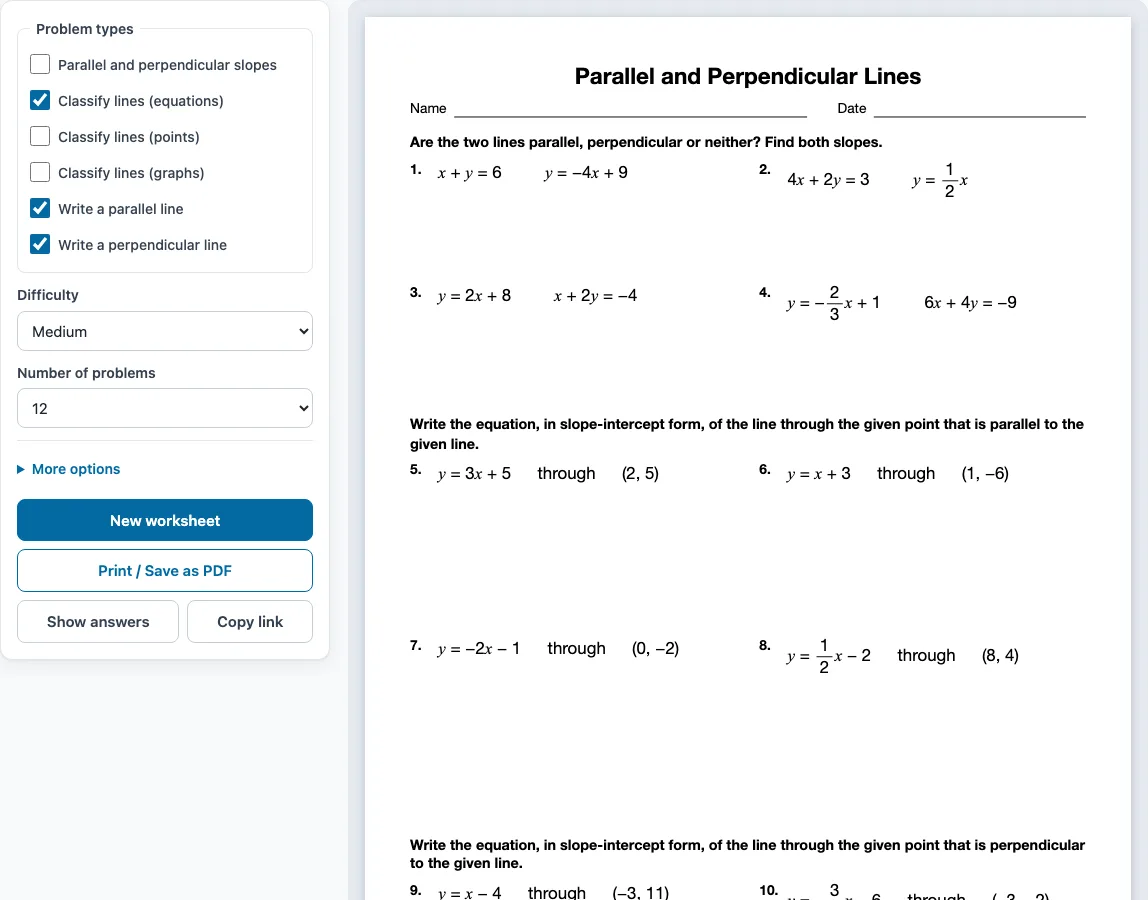
This free parallel and perpendicular lines worksheet generator makes practice sheets in your web browser, with no sign-up needed. You choose the problem types, difficulty and number of problems, and it builds a worksheet with an answer key that you can print or save as a PDF.
The problems cover finding slopes, classifying pairs of lines from equations, points or graphs, and writing the equation of a parallel or perpendicular line through a given point. Nothing is uploaded, because the problems are created on your device. It works for geometry and algebra classes, homework and self-practice, everything you make is free for commercial use such as Teachers Pay Teachers resources, and each new set gives you fresh problems with the same settings.
How to use the Parallel and Perpendicular Lines Worksheet Generator
- Tick one or more boxes under Problem types. The page opens with Classify lines (equations), Write a parallel line and Write a perpendicular line ticked. You can also add Parallel and perpendicular slopes, Classify lines (points) or Classify lines (graphs).
- Choose a level under Difficulty: Easy, Medium or Hard.
- Pick a number under Number of problems, from 6 to 30.
- Open More options to change the layout. You can set Columns (Automatic, 1, 2 or 3), Paper size (Letter or A4), a Worksheet title, a Name and date line, and the answer key on a separate page, which is on by default.
- Check the preview on the right. Press Show answers to see each answer under its problem, and press it again to hide them.
- Press Print / Save as PDF. In the print dialog, choose Save as PDF if you want a file.
If you tick several problem types, the problems are shared evenly between them and grouped under a one-line instruction for each type. Press New worksheet for a fresh random set with the same settings. Copy link saves a link that opens exactly the same worksheet again. Your settings are remembered in this browser, but a shared link uses its own settings.
How do you know if two lines are parallel or perpendicular
Two lines are parallel when they have equal slopes and different y-intercepts. They are perpendicular when their slopes multiply to −1. To check a pair, rewrite each equation as y = mx + b, then compare the m values.
If an equation is in standard form, Ax + By = C, solve it for y first. The slope is then −A/B. For example, 10x − 2y = −7 becomes −2y = −10x − 7, so y = 5x + 7/2 and the slope is 5. The line y = 5x + 3 also has slope 5, so the two lines are parallel. Their intercepts differ, so they are not the same line.
For lines through two points, find each slope with m = (y2 − y1)/(x2 − x1). If the two x-values are equal, the line is vertical and its slope is undefined. For example, (0, 6) and (2, 7) give slope 1/2, while (0, 4) and (3, 7) give slope 1. Since 1/2 and 1 are neither equal nor negative reciprocals, those lines are neither parallel nor perpendicular.
How do you write the equation of a line parallel to another line
Keep the slope of the given line, then find b by substituting the given point into y = mx + b. Solve for b and write the result in slope-intercept form.
For example, find the line parallel to y = 4x + 3 through (2, 10). The slope stays 4, so 10 = 4·2 + b, which gives b = 2. The answer is y = 4x + 2.
The same method works for perpendicular lines, except that you use the perpendicular slope instead of the original one. For the line perpendicular to y = (1/2)x + 1 through (2, 0), the slope is −2, so 0 = −2·2 + b gives b = 4 and the answer is y = −2x + 4. Substitute the point, solve for b, and check that the result passes through the given point.
Sample problems from this generator
- y = −4x − 3 10x + 2y = −5 Answer: Neither m1 = −4, m2 = −5
- x + 2y = −3 y = −12x + 8 Answer: Parallel m1 = −12, m2 = −12
- y = 12x + 7 through (6, 5) Answer: y = 12x + 2
- y = 13x + 4 through (−2, 11) Answer: y = −3x + 5
Frequently asked questions
How do you find a perpendicular slope?
Flip the fraction and change its sign. For 3/4, the perpendicular slope is −4/3. A whole number is written over 1 first, so 5 becomes 5/1, and its perpendicular slope is −1/5.
What is the slope of a line perpendicular to a horizontal line?
A horizontal line has slope 0. A line perpendicular to it is vertical, and a vertical line has an undefined slope. The answer is “undefined,” not 0, and the equation has the form x = a number.
Do I need to rewrite equations before comparing slopes?
Yes, if the equations are in standard form, Ax + By = C. Solve for y to get y = mx + b, and the slope is −A/B. For 7x + 4y = −10, the slope is −7/4.
Can I use these parallel and perpendicular lines worksheets for commercial use?
Yes. You can sell what you make here, for example as a Teachers Pay Teachers resource, an Etsy download or pages in a KDP book. It is royalty-free and needs no credit line. The only limit is that you may not mirror or resell the site or its generators as a competing service.
Does it work on a phone or tablet?
Yes, the generator works on phones and tablets as well as computers. To get a paper copy or a PDF, you need a printer or the Save as PDF option in your browser’s print dialog.
Related tools
- Slope worksheets: Use these for extra practice finding slope from points, graphs and equations before you compare lines.
- Graphing linear equations worksheets: Use these when you need to plot lines from slope-intercept form and check parallel or perpendicular lines visually.
- Angles worksheets: Use these for parallel lines cut by a transversal and the angle relationships they create.
- Systems of equations worksheets: Use these when you want to find where two lines intersect, or see that parallel lines never meet.
- Literal equations worksheets: Use these to practice rearranging formulas, such as solving standard form for y.
- Functions worksheets: Use these to practice linear functions and their rates of change.
- Algebra worksheets: Use this page to browse the full set of algebra worksheet generators.