Pre Algebra Worksheets Generator
Make printable pre-algebra practice for grades 6–8 – expressions, order of operations and first equations – with an answer key on its own page.
Recent
Your last 10 settings, saved only in this browser. Nothing is uploaded.
This free pre-algebra worksheets generator makes printable practice sheets with answer keys, and it runs in your web browser with no sign-up. You choose the problem types, difficulty and number of problems, and the sheet is made on your device, so nothing is uploaded.
Pre-algebra is the bridge from arithmetic to algebra, usually taught in grades 6 to 8. It covers integers, order of operations, exponents, variables and expressions, and one- and two-step equations. Each sheet can be printed directly or saved as a PDF, and every problem has its answer in the key, so the sheets work for class practice, homework or checking your own work at home. Everything you make here is free to use in class or in products you sell, such as Teachers Pay Teachers resources, Etsy printables or KDP workbooks.
How to use the Pre-Algebra Worksheet Generator
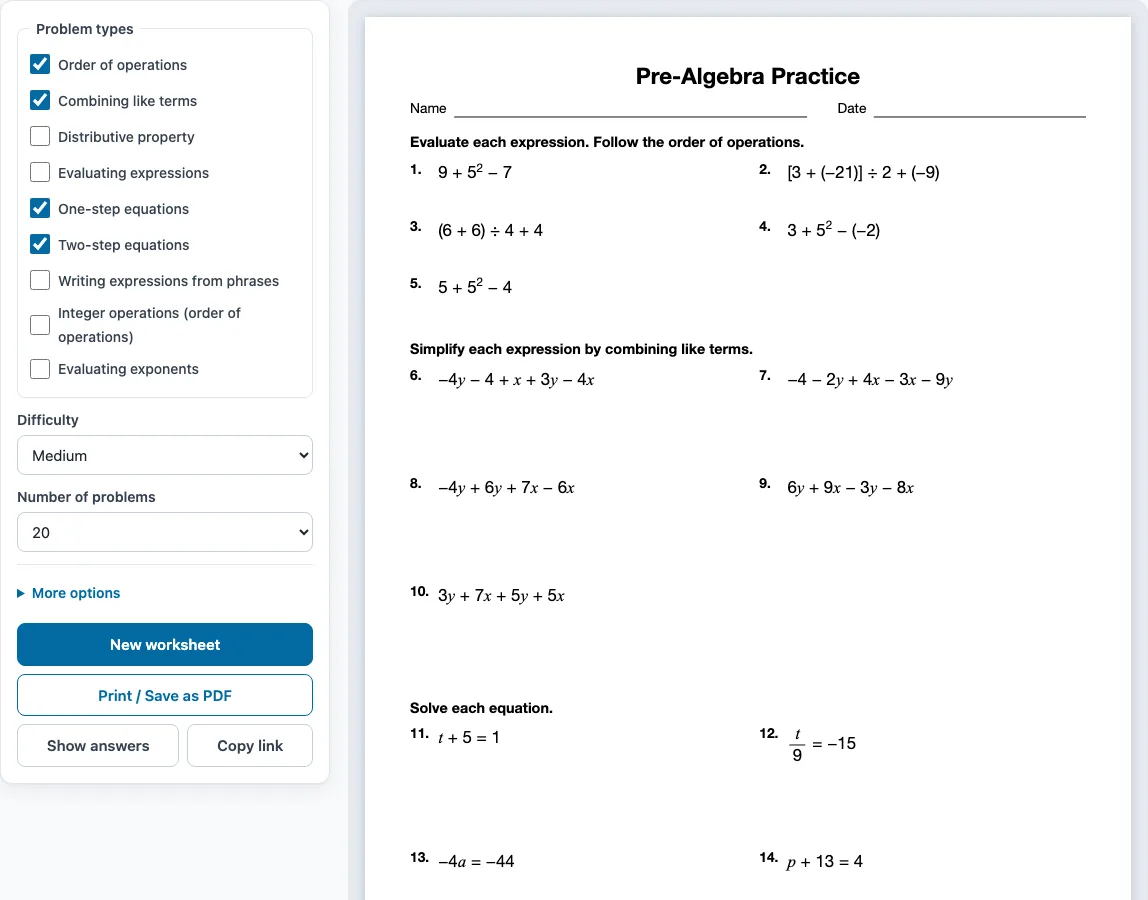
- Under Problem types, tick one or more topics. Order of operations, Combining like terms, One-step equations and Two-step equations are ticked when the page opens.
- Choose a Difficulty: Easy, Medium or Hard. Easy keeps the numbers small and mostly positive; Hard adds negatives, brackets and exponents.
- Pick the Number of problems: 6, 8, 10, 12, 15, 20, 24 or 30.
- Open More options to set the Columns (Automatic, 1, 2 or 3), Paper size (Letter or A4), a Worksheet title, a Name and date line, and whether the Answer key on a separate page is shown (it is on by default).
- Check the preview on the right. It shows the sheet as it will print.
- Press Show answers to see each answer under its problem on screen. Press it again to hide them.
- Press Print / Save as PDF. In the print dialog, choose Save as PDF if you want a file instead of paper.
Press New worksheet for a fresh random set with the same settings. This is useful for printing several versions for a class or for practising again with new numbers. Copy link copies a link that opens exactly the same worksheet later, which is handy when you want to send the same sheet to a whole class.
What is the order of operations?
The order of operations is the agreed sequence for evaluating an expression that has more than one operation, so everyone gets the same answer. Work through grouping symbols first, then exponents, then multiplication and division from left to right, and finally addition and subtraction from left to right. Many people remember this as PEMDAS or GEMDAS.
For example, 11 + 3 × 2 equals 17, not 28. The multiplication comes first, giving 11 + 6, and then the addition gives 17. Grouping symbols can change the order, so 11 + (3 × 2) is the same as 11 + 6, but (11 + 3) × 2 equals 28.
How do you combine like terms?
To combine like terms, add the coefficients of terms that have the same variable raised to the same power. Constant numbers are like terms with each other, but they are not like terms with variables. Terms with different variables, such as x and y, cannot be combined.
Take 8x − 6 + 8 + 5x. Combine 8x and 5x to get 13x, then combine −6 and 8 to get 2, so the result is 13x + 2. Expressions with parentheses are simplified with the distributive property first, so 8(2x − 4) becomes 16x − 32 before any terms are combined.
How do you evaluate an expression?
To evaluate an expression, replace each variable with its given value, put negative values in parentheses, and then follow the order of operations. The Evaluating expressions problems print the values next to the expression, for example 6x − 4y with x = −5 and y = 6.
Substituting gives 6(−5) − 4(6) = −30 − 24 = −54. A Hard example is −x² + 6xy − y with x = 5 and y = −5: the square is worked out first, so −x² = −25, then 6xy = 6(5)(−5) = −150, and subtracting y means subtracting −5, which adds 5. The total is −25 − 150 + 5 = −170. Note that −x² means “the opposite of x squared”, so it is negative even when x is positive.
Every answer in the key is worked out by the same code that writes the problem, so the key always matches the sheet you printed.
Sample problems from this generator
- 22 + (−2) × 4 Answer: −4
- 7y − y − 9x + 5x Answer: −4x + 6y
- p − 20 = −32 Answer: p = −12
- 7a + 4 = −59 Answer: a = −9
Frequently asked questions
What grade is pre-algebra?
Pre-algebra is usually taught in grades 6 to 8. It sits between arithmetic and algebra, so these sheets suit students moving from whole-number work toward variables.
Can I mix topics on one worksheet?
Yes. When you tick several problem types, the problems are shared out evenly between them and grouped by type, with a one-line instruction above each group. Problems are numbered 1 to N across the sheet, and no problem repeats on the same sheet.
What do the difficulty levels look like?
Easy problems are short, such as 11 + 3 × 2, which equals 17. Medium and Hard add more steps and negative numbers, such as 18 − [−11 − (9 − 7)], which equals 31 on the Hard level of integer operations.
Can I use this tool on a phone or tablet?
Yes. It works on phones and tablets as well as computers. Printing needs a printer, but you can use Save as PDF to make a file to share or print later.
Will the tool remember my settings?
Yes. Your settings are remembered in this browser for your next visit. If you open a shared link, the worksheet uses that link’s settings instead.
Which problem types turn words into algebra?
The Writing expressions from phrases type turns phrases into expressions. For example, “9 times a number t, increased by 2” becomes 9t + 2, and “4 times the difference of a number w and 8” becomes 4(w − 8).
Can I put these pre-algebra worksheets in a workbook or a KDP book?
Yes. You can sell what you make here, for example as a Teachers Pay Teachers resource, an Etsy download or pages in a KDP book. It is royalty-free and needs no credit line. The only limit is that you may not mirror or resell the site or its generators as a competing service.
Related tools
- Integers worksheets: use these when you need more practice with negative numbers before working on order of operations.
- Solving equations worksheets: use these for longer equations after you have practised one- and two-step equations.
- Exponents worksheets: use these to practise powers and exponent rules in more depth.
- Inequalities worksheets: use these once you are comfortable solving equations and want to work with greater-than and less-than statements.
- Scientific notation worksheets: use these to practise writing very large and very small numbers in powers of ten.
- Algebra worksheets: use these when you are ready for the next step after pre-algebra.
- Angles worksheets: use these for practice with angle measures and facts, which is a separate topic from the algebra on this page.
- Algebraic expressions worksheets: use these for longer like-terms and distributive problems, including two variables and factoring out the GCF.
- Order of operations worksheets: use these for PEMDAS practice with brackets, exponents, fractions and decimals.
- Unit rate worksheets: use these for rates, unit prices and better buys.
- Distributive property worksheets: use these for a full sheet on the distributive property.