Probability Worksheet Generator
Make printable probability practice with spinners, dice, cards and counting problems, each with an answer key.
Recent
Your last 10 settings, saved only in this browser. Nothing is uploaded.
These probability worksheets are made by a generator that runs in your web browser. You choose the problem types, the difficulty and the number of problems, then print the sheet or save it as a PDF with an answer key on a separate page. It is free, needs no sign-up, and nothing is uploaded.
There are eleven problem types: bags and jars, spinners drawn with equal sections, one die and two dice, a deck of 52 playing cards, the complement of an event, independent events, draws without replacement, the counting principle, experimental probability, the words impossible to certain, and converting between fraction, decimal and percent. Answers are reduced fractions unless the type asks for another form.
You can use the sheets in class or in a tutoring business, with no credit needed.
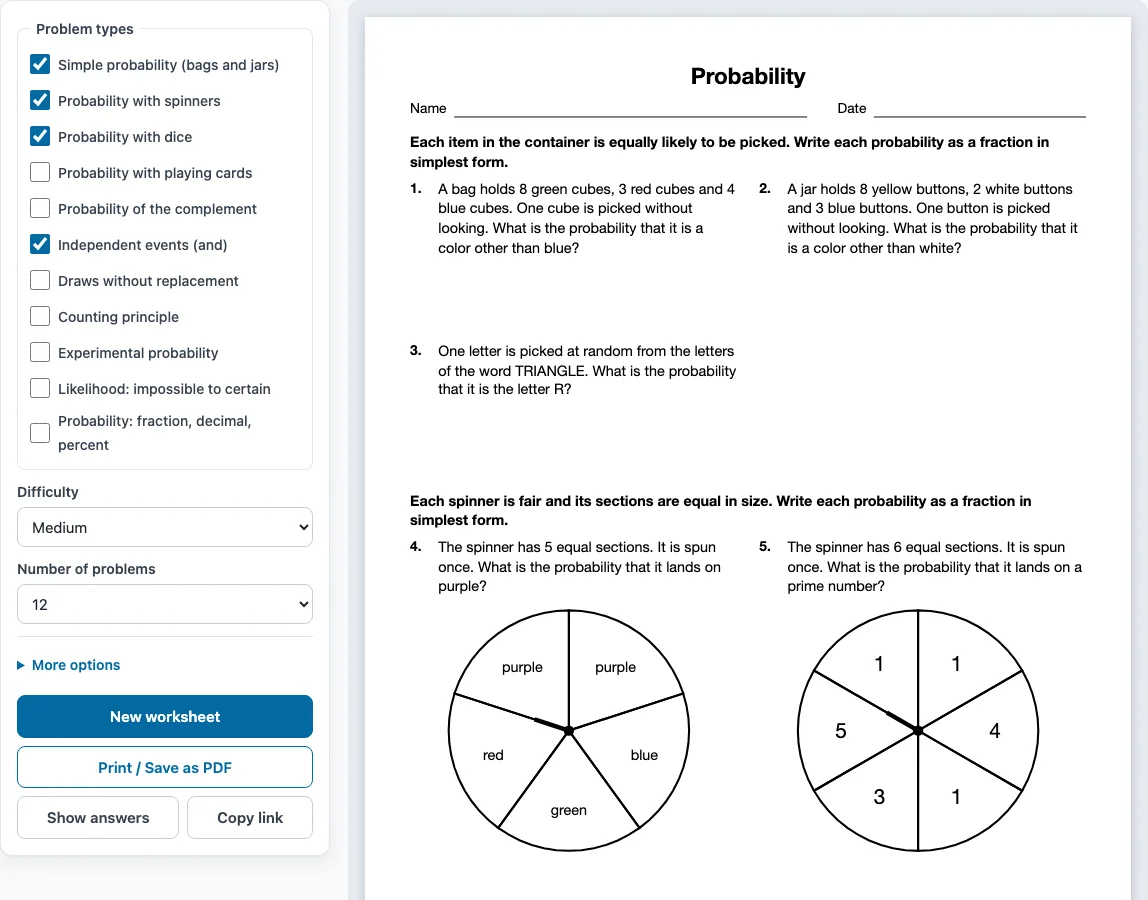
How to use the Probability Worksheet Generator
- Tick one or more boxes under Problem types. The boxes ticked when the page opens are Simple probability, Probability with spinners, Probability with dice and Independent events.
- Choose a level under Difficulty: Easy, Medium or Hard.
- Pick how many problems you want under Number of problems, from 6 to 30.
- Open More options to set the Columns (Automatic, 1, 2 or 3), the Paper size (Letter 8.5 × 11 in or A4 210 × 297 mm), a Worksheet title and the Name and date line.
- Check the preview on the right. Press Show answers to see each answer under its problem, and press it again to hide them.
- Press New worksheet for a fresh random set with the same settings. When you are ready, press Print / Save as PDF, then choose Save as PDF in the print dialog to get a file. Unticking every box leaves the sheet empty, so keep at least one type ticked.
When you tick more than one problem type, the problems are shared out evenly and grouped by type, with a one-line instruction above each group. Copy link saves the problem set as a link, so the same worksheet opens again later. Your settings are remembered in this browser, unless you open a shared link.
How do you find the probability of an event?
Divide the number of outcomes you want by the number of equally likely outcomes in total. A bag with 3 red and 5 blue marbles gives a probability of 3/8 for red. A probability is always between 0 and 1: 0 means impossible and 1 means certain.
Write the answer as a fraction in lowest terms unless the problem asks for a decimal or a percent. The Probability: fraction, decimal, percent type practises moving between the three.
How do you find the probability of two events in a row?
For independent events, where the first result does not change the second, multiply the probabilities. A coin landing heads (1/2) and a die showing 6 (1/6) give 1/12. When you draw without replacement, the second probability changes because one item has left the bag, so the denominator of the second fraction is one smaller. The Draws without replacement type asks exactly this.
What is the probability of an event not happening?
It is 1 minus the probability that it happens. If the chance of rain is 3/10, the chance of no rain is 7/10. This is the complement of the event, and it is often quicker than counting every other outcome.
What is the counting principle?
If one choice can be made in m ways and another in n ways, together they can be made in m × n ways. Three shirts and four pairs of trousers give 12 outfits. The Counting principle type uses outfits, menus and codes, and the Hard level adds more stages and codes with no repeated letter.
What is the difference between theoretical and experimental probability?
Theoretical probability comes from counting equally likely outcomes. Experimental probability comes from results: a coin that landed heads 18 times in 40 tosses has an experimental probability of 18/40, or 9/20, for heads. The Experimental probability type works with tables of results and with predicting how many times something will happen in a number of trials.
Sample problems from this generator
- A bag holds 4 green marbles, 5 white marbles and 5 orange marbles. One marble is picked without looking. What is the probability that it is white? Answer: 514
- The spinner has 8 equal sections. It is spun once. What is the probability that it lands on a color other than green? Answer: 58
- A fair die is rolled once. What is the probability of rolling the number 6? Answer: 16
- Spinner A has 6 equal sections numbered 1 to 6. Spinner B has 5 equal sections numbered 1 to 5. Each spinner is spun once. What is the probability of getting a number less than 2 on A and a number less than 2 on B? Answer: 130
Frequently asked questions
What do the spinner problems look like?
Each spinner is drawn as a circle split into 4, 5, 6 or 8 equal sections, labelled with numbers or colours. Students find the probability of landing on a number, an even number or a colour.
Which cards are in the deck?
A standard deck of 52 cards with no jokers: four suits of 13 cards each, with 12 face cards. The Hard level includes questions where two events overlap, such as a black card or a king.
Are the answers reduced?
Yes. Probabilities are written as fractions in lowest terms, and the answer key shows the reduced form. Impossible and certain appear as the words in the Likelihood type rather than as 0 and 1.
Can I make a worksheet for a younger class?
Use Easy level with Simple probability, Likelihood and Probability with spinners. Easy problems use small counts and a single event.
Does the worksheet come with answers?
Yes. By default the answer key prints on a separate page after the worksheet. Press Show answers to see each answer under its problem in the preview, and untick Answer key on a separate page under More options if you want to leave the key out.
Can I use these worksheets in my class or tutoring business?
Yes. You can use the worksheets you make here at home, in school and in a tutoring business, and you do not need to give credit. You may not resell them as a stand-alone product or copy the generator itself; see the terms.
Related tools
- Mean median mode worksheets: use these for averages from the same data and statistics unit.
- Box and whisker plot worksheets: use these for another way to describe data with quartiles.
- Percent worksheets: use these to turn probabilities into percents.
- Gcf lcm worksheets: use these to practise reducing fractions to lowest terms.
- Unit rate worksheets: use these for rates and ratios that sit beside probability.
- Word problems worksheets: use these for more word problems that turn sentences into equations.
- Integers worksheets: use these for more number-sense practice.
- Pre algebra worksheets: use these for a wider set of skills that come before algebra.