Radical Simplification Worksheet Generator
Make printable radicals practice – simplifying square roots, like radicals, products and denominators – with fully simplified answers in the key.
Recent
Your last 10 settings, saved only in this browser. Nothing is uploaded.
A radical simplification worksheet is a practice sheet where you rewrite roots in simplest form, such as turning √40 into 2√10. This Radicals Worksheet Generator makes one for you in your web browser, for free, with no sign-up. The problems are made on your device, and nothing is uploaded.
You can choose from six problem types: simplifying square roots, simplifying with variables, adding and subtracting radicals, multiplying radicals, rationalizing the denominator, and cube roots. You can pick easy, medium, or hard problems, set how many appear, and include an answer key. Print the sheet or save it as a PDF for a simplifying radicals worksheet you can share. It works on phones and tablets as well as computers. Everything you make here is free to use in class or in products you sell, such as Teachers Pay Teachers resources, Etsy printables or KDP workbooks.
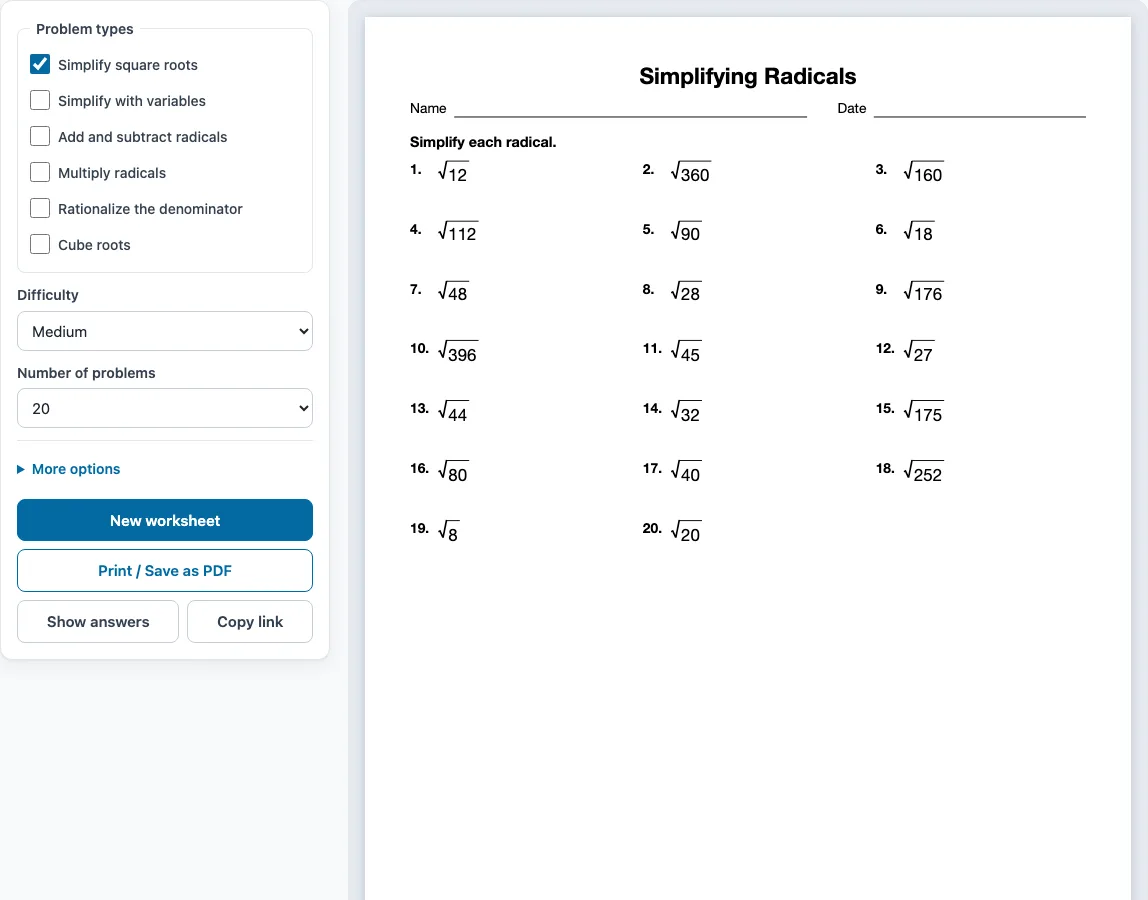
How to use the Radicals Worksheet Generator
- Tick one or more boxes under Problem types. Only Simplify square roots is ticked when the page opens. If you tick several, the problems are shared evenly between them and grouped by type, each group with its own instruction.
- Choose a Difficulty: Easy, Medium, or Hard.
- Pick a Number of problems: 6, 8, 10, 12, 15, 20, 24, or 30.
- Open More options if you want to change the layout. You can set Columns (Automatic, 1, 2, or 3), Paper size (Letter or A4), a Worksheet title, and a Name and date line. The Answer key on a separate page box is on by default.
- Check the preview on the right. It shows the sheet as it will print.
- Click Show answers to see each answer under its problem on screen. Click again to hide them.
- Click New worksheet for a fresh random set with the same settings. The numbers change, but the problem types and difficulty stay as you set them.
- Click Print / Save as PDF. In the print dialog, choose Save as PDF if you want a file.
Your settings are remembered in this browser for your next visit. To send someone the exact same worksheet, click Copy link. The link opens that worksheet again, using the settings stored in it.
How do you simplify radicals?
To simplify a square root, write the number as the largest perfect square times the rest, then split the root with √(a·b) = √a · √b. For example, √40 = √4 · √10 = 2√10. A radical is fully simplified when no perfect square other than 1 divides the number under the root, and no root is left in a denominator.
Coefficients outside the root multiply with each other. So 5√350 = 5 · 5√14 = 25√14, because 350 = 25 · 14. With variables, assume they are non-negative. Then √(x²) = x, and you pull out one copy of each variable for every pair under the root. For example, √(490x²y⁵) = 7xy²√(10y), since 490 = 49 · 10 and y⁵ = y⁴ · y.
How do you multiply radicals?
Multiply radicals by combining the numbers under one root: √a · √b = √(ab). Then simplify the result. For example, √17 · √18 = √306 = √(9 · 34) = 3√34.
When a binomial is involved, multiply each term in the first part by each term in the second, as in (a + b)(c + d). Then combine like terms. For example, (5 + 3√7)(−5 + 2√7) = −25 + 10√7 − 15√7 + 6 · 7 = 17 − 5√7. Note that 3√7 · 2√7 = 6 · 7 = 42, which is a whole number, not a radical.
How do you add and subtract radicals?
You can add or subtract only like radicals, which have the same number under the root. Simplify each radical first, then combine the coefficients of the matching ones. For example, 3√45 − 2√48 + 5√5 − 5√3 becomes 9√5 + 5√5 − 8√3 − 5√3 = 14√5 − 13√3.
How do the difficulty levels change the radicals?
Easy problems use small numbers, often with a perfect square factor that is easy to spot, such as √8 = 2√2, and some Easy cube roots are perfect cubes like ∛216 = 6. Medium problems use larger numbers such as √40 or products like √17 · √18, where you multiply first and then look for the square factor in 306 = 9 · 34. Hard problems put a coefficient in front of the root (5√350), mix several unlike radicals in one sum, multiply two binomials, or need the conjugate to clear a denominator. In every answer the number under the root has no square factor left, so you can compare your own answer with the key term by term.
Sample problems from this generator
- √396 Answer: 6√11
- √112 Answer: 4√7
- √72 Answer: 6√2
- √48 Answer: 4√3
Frequently asked questions
How do you rationalize the denominator?
Rationalizing the denominator means removing the root from the bottom of a fraction. Multiply the top and bottom by the root, so 11/√7 = 11√7/7. If the denominator has the form a + b√c, multiply by its conjugate, a − b√c, instead. For example, 12/(6 − 3√7) = (−8 − 4√7)/3.
How do you simplify cube roots?
Pull out any factor that is a perfect cube, just as you pull out perfect squares for square roots. For example, ∛216 = 6, and ∛189 = ∛(27 · 7) = 3∛7. The cube root of a negative number is negative, so ∛(−864) = −6∛4.
Is there an answer key?
Yes. The Answer key on a separate page box is on by default. When you print, the key starts on a new page after the worksheet and lists every problem number with its answer. To check answers on screen first, use Show answers.
Why are the variables assumed to be non-negative?
In general √(x²) = |x|, the absolute value of x, because squaring hides the sign. The problems with variables say “Assume all variables are non-negative”, so √(x²) can be written simply as x and the answers stay clean, such as √(25x²) = 5x.
Does this tool make radical equations to solve?
No. The six problem types cover simplifying, adding and subtracting, multiplying, rationalizing denominators, and cube roots. Solving equations that contain radicals is not one of them, so use the related pages below for other practice.
Can I use the radicals worksheets I make in my tutoring business or my TpT store?
Yes. You can sell what you make here, for example as a Teachers Pay Teachers resource, an Etsy download or pages in a KDP book. It is royalty-free and needs no credit line. The only limit is that you may not mirror or resell the site or its generators as a competing service.
Related tools
- Quadratic equations worksheets: Use these for solving equations, including ones where the quadratic formula gives square roots.
- Exponents worksheets: Use these to practice the exponent rules that connect to roots.
- Pythagorean theorem worksheets: Use these when your answers are side lengths that often involve square roots.
- Factoring worksheets: Use these to practice pulling common factors out of expressions, a skill similar to pulling perfect squares out of a root.
- Scientific notation worksheets: Use these to practice writing very large and very small numbers in a compact form.
- Algebra worksheets: Use this page to browse all the practice tools on the site.
- Algebra 2 worksheets: use these for mixed review that includes rationalizing denominators.
- Special right triangles worksheets: use these to apply simplest radical form to triangle sides.