Similar Shape Worksheet Generator
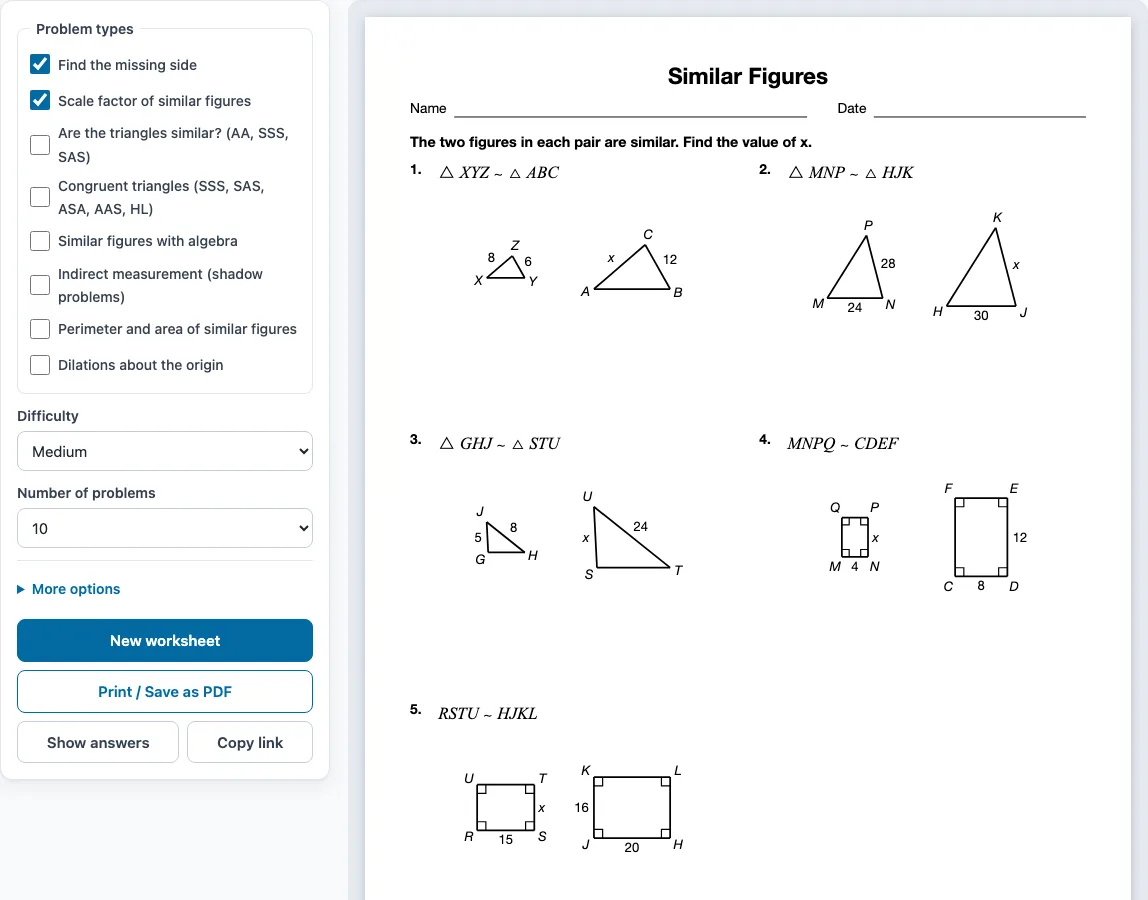
Make printable worksheets on similar and congruent figures – every problem comes with its own diagram, and the answer key gives each missing side, scale factor or rule.
Recent
Your last 10 settings, saved only in this browser. Nothing is uploaded.
How to use the similar shapes worksheet generator
- Tick one or more problem types under Problem types. When several are ticked, the problems are shared evenly between them and grouped by type, with a one-line instruction above each group.
- Choose a Difficulty: Easy, Medium or Hard.
- Choose the Number of problems, from 6 to 30.
- Open More options to set the columns (Automatic, 1, 2 or 3), the paper size (Letter or A4), a worksheet title, and whether to print a name and date line. The answer key on a separate page is on by default.
- Check the preview on the right, which shows the sheet as it will print. Press Show answers to see each answer under its problem.
- Press Print / Save as PDF. In the print dialog, choose “Save as PDF” if you want a file.
Every problem is printed with its own diagram, and with Columns on Automatic the sheet puts two diagram problems side by side in each row. The shapes, side lengths and vertex letters change with every new worksheet.
New worksheet creates a fresh random set with the same settings, which is useful for printing several versions. Copy link saves the exact problem set in a link that opens the same worksheet again. The settings are remembered in your browser for your next visit, unless you open a shared link.
How do you find a missing side of similar figures?
To find a missing side of similar figures, write a proportion that compares corresponding sides, then solve it for the unknown. Similar figures have the same shape: their corresponding angles are equal and their corresponding sides are in the same ratio.
The letter order in a similarity statement tells you which parts correspond. In △ABC ∼ △DEF, A matches D, B matches E and C matches F. So side AB corresponds to side DE, and BC corresponds to EF.
- Find one pair of corresponding sides where both lengths are known.
- Write that pair as a fraction, with the original side and the image side in matching positions.
- Write the unknown as a fraction in the same positions, using the side that corresponds to the missing one.
- Set the two fractions equal and cross-multiply, then solve.
For example, if a side of 4 in one triangle matches a side of 6 in a similar triangle, and a side of 10 in the first triangle matches x in the second, then 4/10 = 6/x. Cross-multiplying gives 4x = 60, so x = 15.
What is a scale factor?
A scale factor is the number k that turns one figure into a similar figure. It equals the side length of the image divided by the corresponding side length of the original: k = (side of image) ÷ (corresponding side of original). If k is greater than 1, the image is an enlargement. If k is between 0 and 1, the image is a reduction.
Write k as a whole number or as a fraction in lowest terms. If an original side is 4 and the matching image side is 10, then k = 10/4 = 5/2.
The scale factor also sets the other measurements. Perimeters are in the ratio k, and areas are in the ratio k². With k = 2, the perimeter doubles and the area becomes four times as large.
For dilations about the origin, multiply each coordinate by k. With k = 2, the point (1, −1) maps to (2, −2).
Sample problems from this generator
- △ GHJ ∼ △ QRS Answer: x = 32
- HJKL ∼ CDEF Answer: x = 10
- CDEF ∼ VWXY Answer: k = 2
- ABCD ∼ JKLM Answer: k = 32
Frequently asked questions
Is there an answer key?
Yes. The Answer key on a separate page option is on by default. When you print, the key starts on a new page after the worksheet and lists every problem number with its answer. For dilation problems the key draws the image on the grid.
What is the difference between similar and congruent?
Similar figures have the same shape but can differ in size, so their sides are proportional. Congruent figures have the same shape and the same size, so their matching sides and angles are equal. Every congruent pair is also similar, with a scale factor of 1.
How do you prove triangles are congruent (SSS, SAS, ASA, AAS, HL)?
Use one of five rules: SSS (three pairs of equal sides), SAS (two pairs of equal sides with the included angle equal), ASA (two pairs of equal angles with the included side equal), AAS (two pairs of equal angles and a non-included side equal), or HL (for right triangles, equal hypotenuses and one pair of equal legs). AAA and SSA do not prove congruence. On a diagram, tick marks show equal sides and arcs show equal angles.
How can I get a PDF of a similar shapes worksheet?
Press Print / Save as PDF, then choose “Save as PDF” in the browser’s print dialog. The worksheet and the answer key both go into the same file if the answer key option is on.
Can I make a different set of problems with the same settings?
Yes. Press New worksheet to get a fresh random set with the same settings. Each click gives different problems, so a teacher can print several versions, or a student can practise again with new numbers.
Does it work on a phone or tablet?
Yes. The generator works on phones and tablets as well as computers. Printing needs a printer or the “Save as PDF” option in your browser.
Are these similar shapes worksheets OK for Teachers Pay Teachers and Etsy?
Yes. You can sell what you make here, for example as a Teachers Pay Teachers resource, an Etsy download or pages in a KDP book. It is royalty-free and needs no credit line. The only limit is that you may not mirror or resell the site or its generators as a competing service.
Related tools
- Transformations worksheets: use these for more practice with dilations and other transformations.
- Angles worksheets: use these to practise the angle facts needed to show triangles are similar or congruent.
- Pythagorean theorem worksheets: use these to find missing sides in right triangles, which is useful for the HL rule.
- Solving equations worksheets: use these to practise the cross-multiplying and solving steps used in proportions.
- Percent worksheets: use these for ratio and percent practice that builds on scale factors.
- Algebra worksheets: use these to find other practice sheets across algebra topics.
- Volume and surface area worksheets: use these for volume and surface area of solids.