Dilation Worksheet & Transformations Generator
Make printable transformation practice on coordinate grids – dilate, translate, reflect or rotate a figure – with the image drawn in the answer key.
Recent
Your last 10 settings, saved only in this browser. Nothing is uploaded.
This free Transformations Worksheet Generator makes printable dilation worksheets, along with worksheets for translations, reflections, rotations and sequences of transformations. Each problem shows a figure on a coordinate grid, and students write the coordinates of the image. It runs in your web browser with no sign-up, and nothing you create is uploaded.
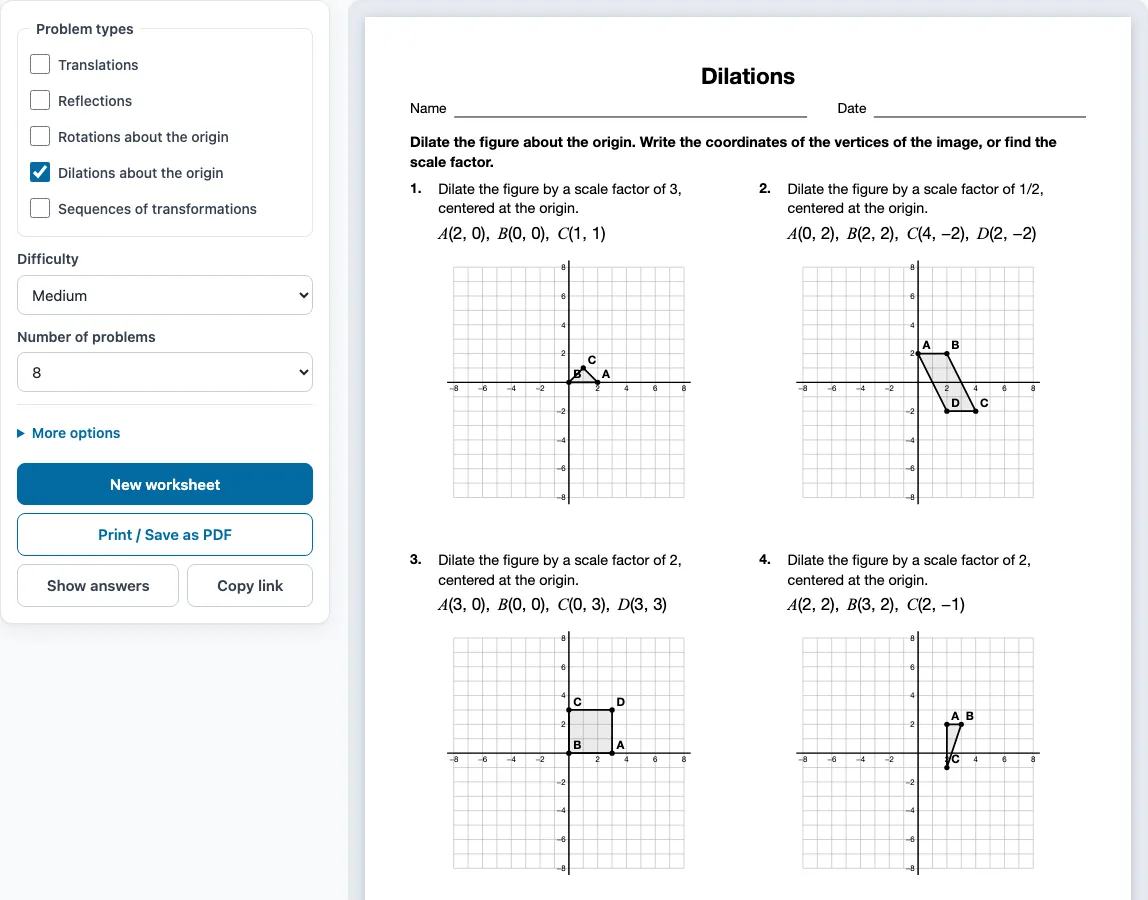
You choose the problem types, the difficulty, and the number of problems. The problems are made on your device, and the answer key can go on a separate page. Teachers can make several versions of the same sheet, and students can practise with new numbers. The dilation worksheets cover both finding image coordinates and finding the scale factor, so the sheet works for a geometry lesson or a review at home. Everything you make here is free to use in class or in products you sell, such as Teachers Pay Teachers resources, Etsy printables or KDP workbooks.
How to use the Transformations Worksheet Generator
- Under Problem types, tick one or more boxes. Dilations about the origin is already ticked when the page opens. If you tick several types, the problems are shared evenly between them, and each group gets its own instruction line.
- Under Difficulty, choose Easy, Medium or Hard. Hard dilation problems ask you to find the scale factor from a figure and its image.
- Under Number of problems, choose 6, 8, 10, 12, 15, 20, 24 or 30. Problems are numbered 1 to N across the sheet, and no problem repeats on one sheet.
- Open More options if you want to change the layout. You can pick the number of columns (Automatic, 1, 2 or 3), the paper size (Letter 8.5 × 11 in or A4 210 × 297 mm), a worksheet title, and a name and date line. Leave Answer key on a separate page ticked if you want one.
- Check the preview on the right. It shows the sheet as it will print.
- Click Show answers to see each answer under its problem in the preview. Click it again to hide them.
- Click New worksheet for a fresh set of problems with the same settings.
- Click Print / Save as PDF. Choose Save as PDF in the print dialog if you want a file instead of paper.
The Copy link button copies a link that opens the same worksheet again. Your settings are remembered in this browser for your next visit. The tool works on phones and tablets too, but printing needs a printer or the Save as PDF option.
How do you dilate a figure?
To dilate a figure about the origin with scale factor k, multiply each coordinate by k. The rule is (x, y) → (kx, ky). If k is greater than 1, the figure gets larger. If k is between 0 and 1, the figure gets smaller. The image has the same shape as the original, so its angles stay the same and its side lengths are multiplied by k.
For example, the point A(1, −1) with k = 2 maps to A′(2, −2), because 2 × 1 = 2 and 2 × (−1) = −2. A triangle with vertices A(1, −1), B(3, −1) and C(1, 1) dilated by 2 gives A′(2, −2), B′(6, −2) and C′(2, 2). Each side of the image is twice as long as the matching side of the original.
How do you find the scale factor of a dilation?
Divide the image coordinate by the original coordinate, or divide the image length by the original length. When the figure is centered at the origin, you can use any single pair of matching points. The scale factor is the same for every pair.
For example, A(−3, −3) maps to A′(−1, −1). Dividing −1 by −3 gives 1/3, so k = 1/3, and the figure shrinks. Check your answer with a second point. B(−6, −3) maps to B′(−2, −1). Dividing −2 by −6 also gives 1/3. Hard problems often use factors such as 3/2 and 1/3, so always check the sign and the size of the number.
Sample problems from this generator
- Dilate the figure by a scale factor of 3, centered at the origin. A(1, 1), B(2, 1), C(2, 0) Answer: A′(3, 3), B′(6, 3), C′(6, 0)
- Dilate the figure by a scale factor of 1/2, centered at the origin. A(4, 0), B(6, 0), C(6, −2), D(4, −2) Answer: A′(2, 0), B′(3, 0), C′(3, −1), D′(2, −1)
- Dilate the figure by a scale factor of 2, centered at the origin. A(−3, 1), B(0, 1), C(−1, −1), D(−2, −1) Answer: A′(−6, 2), B′(0, 2), C′(−2, −2), D′(−4, −2)
- Dilate the figure by a scale factor of 3, centered at the origin. A(0, 1), B(1, 1), C(1, −1), D(0, −1) Answer: A′(0, 3), B′(3, 3), C′(3, −3), D′(0, −3)
Frequently asked questions
What are the rotation rules for 90°, 180° and 270°?
For a counterclockwise rotation about the origin, 90° maps (x, y) to (−y, x). 180° maps (x, y) to (−x, −y). 270° maps (x, y) to (y, −x). Some Hard sheets use clockwise wording. A clockwise 90° turn is the same as a counterclockwise 270° turn, so use the 270° rule.
What are the reflection rules?
Over the x-axis, (x, y) maps to (x, −y). Over the y-axis, (x, y) maps to (−x, y). Over the line y = x, (x, y) maps to (y, x). Over the line y = −x, (x, y) maps to (−y, −x). Hard sheets also use vertical lines x = k and horizontal lines y = k.
Is there an answer key?
Yes. The answer key is on by default and prints on a new page after the worksheet. It lists every problem number with its answer, and it draws the image on the grid when the answer is a picture. You can also click Show answers to check problems on screen. Untick the answer key box if you want the sheet without it.
Are dilations and rotations the same kind of transformation?
No. Translations, reflections and rotations keep the size and shape of the figure, so their images are congruent to the original. A dilation changes the size, so its image is similar to the original. That is why dilation worksheets are often grouped with similarity transformations.
Can I make several versions of the same worksheet?
Yes. Each click on New worksheet gives different problems with the same settings. You can print several versions for different groups of students, or use new problems for more practice.
Does the tool use an online service to make the problems?
No. The problems are made on your device in the browser, and the free tool does not upload them. You only need a printer or the Save as PDF option to keep a copy.
Can I sell the transformations worksheets I make here on Teachers Pay Teachers?
Yes. You can sell what you make here, for example as a Teachers Pay Teachers resource, an Etsy download or pages in a KDP book. It is royalty-free and needs no credit line. The only limit is that you may not mirror or resell the site or its generators as a competing service.
Related tools
- Angles worksheets: Use these for angle measures with parallel lines, angle pairs and triangles.
- Pythagorean theorem worksheets: Use these to practise finding side lengths in right triangles, a common step after working with dilated figures.
- Slope worksheets: Use these to practise reading slopes on a coordinate grid, the same skill used to plot points on a transformed figure.
- Systems of equations worksheets: Use these when you need practice graphing two lines on a coordinate grid and finding where they meet.
- Integers worksheets: Use these to practise working with negative numbers, which appear often in coordinates after reflections and rotations.
- Algebra worksheets: Use this page to find other worksheets for algebra and geometry topics.
- Similar shapes worksheets: use these for scale factors, missing sides of similar figures and congruent triangles.