Unit Rate Worksheet Generator
Make printable rate and unit rate practice – speeds, wages, unit prices, better buys, tables, graphs and unit rates with fractions – with an answer key.
Recent
Your last 10 settings, saved only in this browser. Nothing is uploaded.
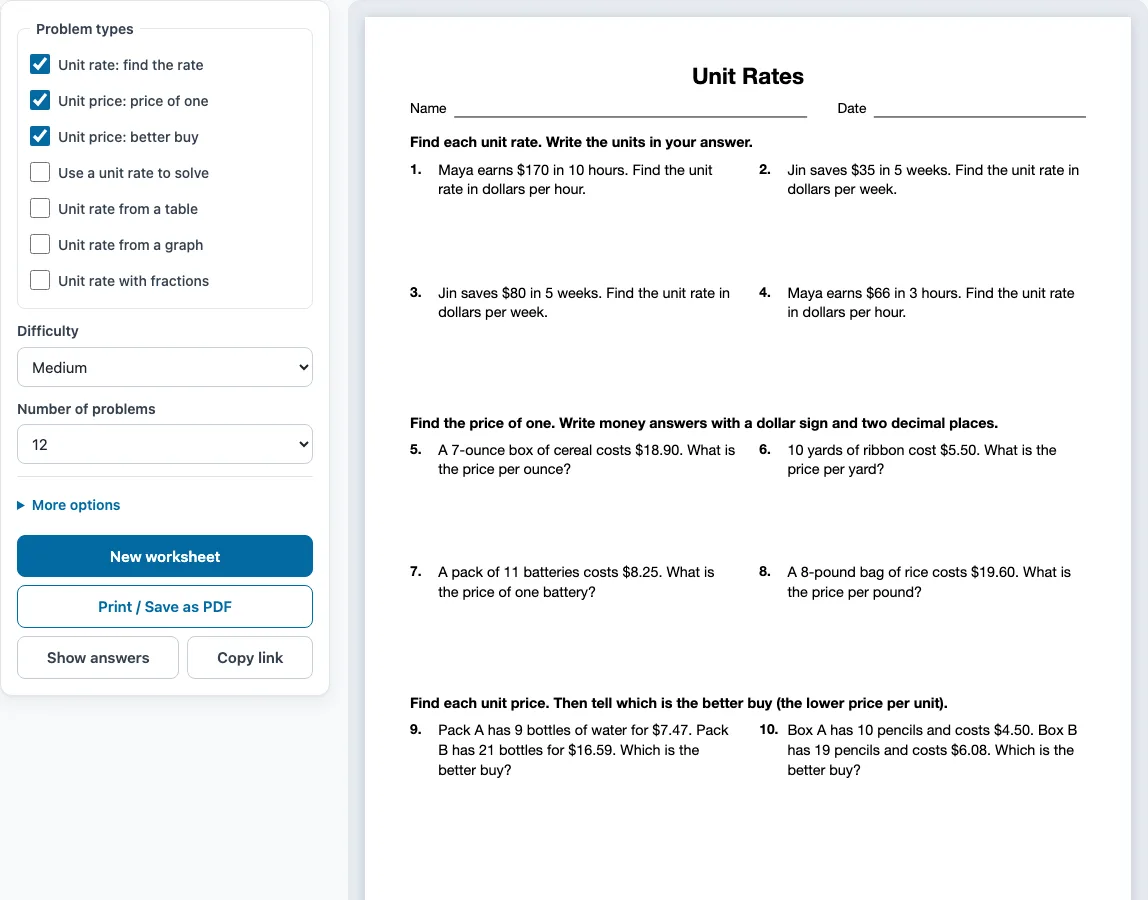
How to use the unit rate worksheet generator
- Open the Problem types checkboxes on the left and tick one or more: Unit rate: find the rate, Unit price: price of one, Unit price: better buy, Use a unit rate to solve, Unit rate from a table, Unit rate from a graph, or Unit rate with fractions. Three types are ticked when the page opens.
- Choose a level under Difficulty: Easy, Medium or Hard.
- Pick a value under Number of problems: 6, 8, 10, 12, 15, 20, 24 or 30.
- Open More options to set the Columns (Automatic, 1, 2 or 3), the Paper size (Letter 8.5 × 11 in or A4 210 × 297 mm), a Worksheet title, and the Name and date line checkbox. The Answer key on a separate page box is on by default.
- Check the preview on the right. Press Show answers to see each answer under its problem, and press it again to hide them.
- Press Print / Save as PDF. In the print dialog, choose Save as PDF if you want a file.
When several problem types are ticked, the problems are shared evenly between them and grouped by type, each group under its own instruction. Press New worksheet for a fresh random set with the same settings. Press Copy link to copy a link that opens exactly the same worksheet again. Your settings are remembered in this browser for your next visit, unless you open a shared link, which uses that link’s settings.
How do you find a unit rate
To find a unit rate, divide the first quantity by the second, so the answer is the amount for exactly one unit. For example, 120 miles in 3 hours is 120 ÷ 3 = 40 miles per hour. Always keep the units in your answer, because they show what the rate measures.
For money, the unit price is the total price divided by the number of units, rounded to the cent. $8.75 for 5 ounces is $8.75 ÷ 5 = $1.75 per ounce. You can also use a unit rate to solve problems. If 4 notebooks cost $6, one notebook costs $1.50, so 10 notebooks cost $15.
Fractions work the same way. A rate of 1/2 mile in 1/4 hour is (1/2) ÷ (1/4) = 2 miles per hour.
How do you find a unit rate with fractions?
Divide the first quantity by the second, just as with whole numbers, but use fraction division: multiply by the reciprocal. For example, 1 4/5 cups for 2 2/5 batches gives (9/5) ÷ (12/5) = (9/5) × (5/12) = 3/4 cup per batch. The Unit rate with fractions type asks questions like this, and the answer key gives each unit rate in simplest form.
What is the difference between a rate and a unit rate
A rate compares two quantities measured in different units, such as 120 miles in 3 hours. A unit rate is a rate in which the second quantity is exactly one unit, such as 40 miles per hour. Every unit rate is a rate, but a rate becomes a unit rate only after you divide so that the second quantity equals one.
This is why the worksheets ask for answers like “dollars per week” or “words per minute.” The unit in the answer tells you which quantity has been set to one.
Sample problems from this generator
- Lena types 65 words in 5 minutes. Find the unit rate in words per minute. Answer: 13 words per minute
- Jin saves $48 in 4 weeks. Find the unit rate in dollars per week. Answer: $12.00 per week
- A 10-pound bag of rice costs $8. What is the price per pound? Answer: $0.80 per pound
- Pack A has 11 bottles of water for $5.94. Pack B has 22 bottles for $14.30. Which is the better buy? Answer: A:$0.54 per bottle B:$0.65 per bottle A is the better buy
Frequently asked questions
How do you find the better buy?
Find the unit price of each option by dividing its total price by its number of units. The option with the lower unit price is the better buy. For example, Pack B has 8 bottles for $1.20, which is $0.15 per bottle, and Pack A has 4 bottles for $1.20, which is $0.30 per bottle, so Pack B is the better buy.
How do you find the unit rate from a graph or table?
If a table or graph shows a proportional relationship, the unit rate is y ÷ x for any pair of values. On a straight line through the origin, the point (1, r) shows the unit rate r directly, and that same number is the slope.
Can I use these unit rate worksheets for commercial use?
Yes. Everything you make here is royalty-free for personal, classroom and commercial use, including Teachers Pay Teachers, Etsy printables, KDP workbooks and print-on-demand products. No credit is required. The only thing you may not do is copy the generator or the site itself to run a competing service. See the terms.
Do I need an account to make a worksheet?
No. The generator is free, runs in your web browser and needs no sign-up. Nothing is uploaded, because the problems are made on your device.
Can I make different versions for the same class?
Yes. Each click on New worksheet gives different problems with the same settings, so you can print several versions, for example one per row of desks. No problem repeats on one sheet.
How hard are the Hard problems?
Hard rates have at most two decimal places, and money answers are to the cent. The Unit rate with fractions type uses fractions and mixed numbers, and answers are written in simplest form.
Related tools
- Slope worksheets: Use these when you want to connect a unit rate on a graph to the slope of a line.
- Similar shapes worksheets: Use these to practise proportions in the context of scale and similar figures.
- Percent worksheets: Use these for percent of a price, discounts and other money comparisons.
- Word problems worksheets: Use these for multi-step equation word problems once unit rates feel comfortable.
- Simple interest worksheets: Use these to practise rate-times-time calculations with money.
- Pre-algebra worksheets: Use these to review the wider set of skills that unit rates build on.