Volume of Cylinder Worksheet Generator
Make printable volume of a cylinder questions – plus cones, spheres, prisms, pyramids and surface area – drawn and labelled, answers exact and to the nearest tenth.
Recent
Your last 10 settings, saved only in this browser. Nothing is uploaded.
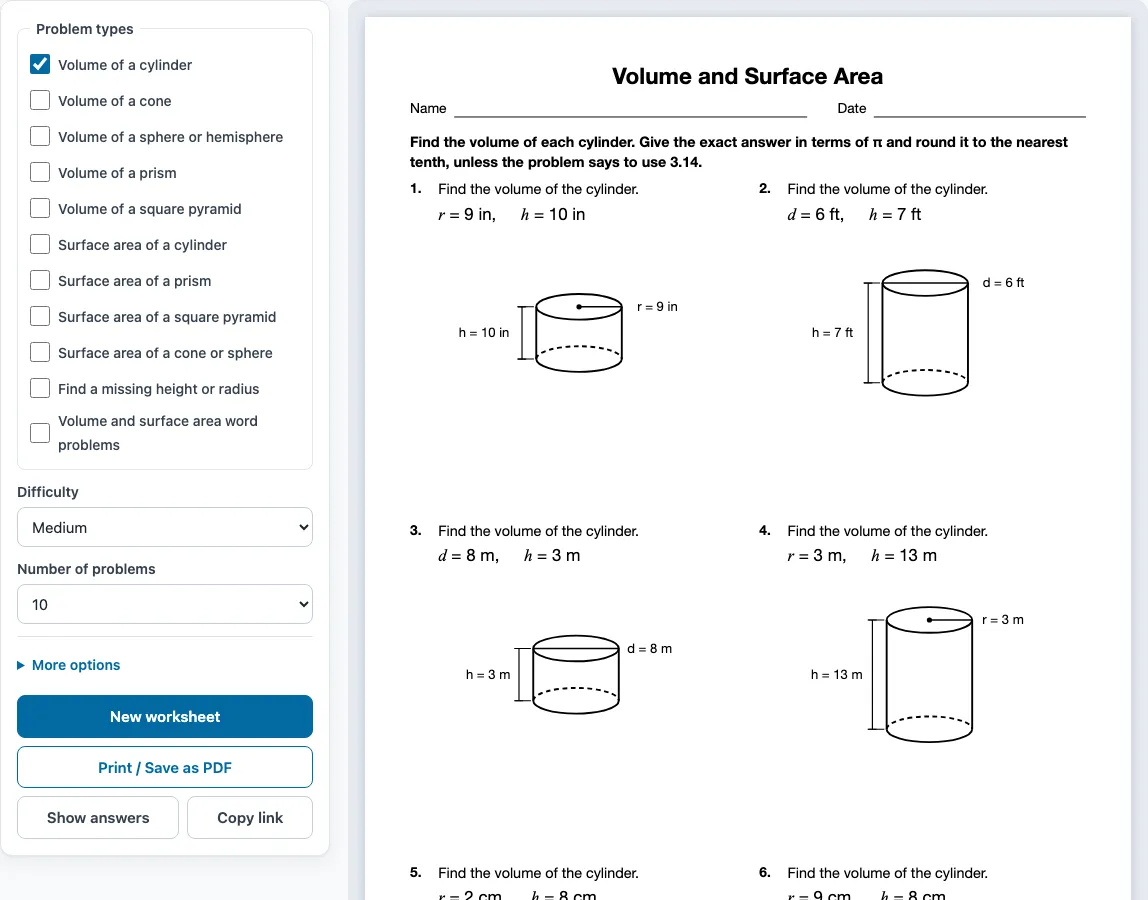
How to use the worksheet generator
- Under Problem types, tick one or more boxes. Volume of a cylinder is ticked by default. If you tick several types, the problems are shared out evenly between them and grouped by type, each group with its own instruction.
- Under Difficulty, choose Easy, Medium or Hard.
- Under Number of problems, choose a number from 6 to 30.
- Open More options to set the Columns (Automatic, 1, 2 or 3), the Paper size (Letter 8.5 × 11 in or A4 210 × 297 mm), a Worksheet title, and the Name and date line checkbox if you want students to fill it in.
- Check the preview on the right. It shows the sheet as it will print. Press Show answers to display the answers under each problem on screen, and press it again to hide them.
- Press Print / Save as PDF. In the print dialog, choose Save as PDF if you want a file instead of paper.
The answer key is on a separate page by default. Untick Answer key on a separate page if you do not want it. Copy link saves the exact problem set, and anyone who opens the link gets the same worksheet. Your settings are remembered in this browser for your next visit, unless you open a shared link, which uses that link’s settings. The tool also works on phones and tablets. Printing needs a printer, or you can use Save as PDF.
What is the formula for the volume of a cylinder?
The volume of a cylinder is V = πr²h, where r is the radius of the circular base and h is the height. You find the area of the base, πr², and multiply it by the height. If a problem gives you a diameter instead of a radius, halve it first.
For example, a cylinder with r = 4 m and h = 8 m has V = π × 4² × 8 = 128π ≈ 402.1 m³. The answer is exact in terms of π, then rounded to the nearest tenth. Some Hard problems say to use 3.14 for π, so check the instruction before you round. Volume is always in cubic units, such as m³ or ft³, because you are multiplying three lengths together.
How do you find the volume of a cone and a sphere?
A cone has a volume of one third of a cylinder with the same radius and height: V = (1/3)πr²h. A sphere has V = (4/3)πr³, and a hemisphere, which is half a sphere, has half of that volume.
For a sphere with r = 3 ft, the volume is (4/3)π × 3³ = 36π ≈ 113.1 ft³. For a cone with a diameter of 18 m and a height of 9 m, the radius is 9 m, so V = (1/3)π × 9² × 9 = 243π ≈ 763.4 m³. Practise these formulas together with the cylinder to see how the shapes compare.
How do you find the volume of a prism or a pyramid?
A prism has the same cross-section all the way through, so its volume is the base area times the length. A rectangular prism is V = lwh, for example 6 × 6 × 7 = 252 m³. A triangular prism is (1/2) × base × height of the triangle × length. A square pyramid holds one third of the matching prism: V = (1/3)s²h, so s = 5 m and h = 9 m give 75 m³.
Sample problems from this generator
- Find the volume of the cylinder. r = 4 m, h = 14 m Answer: V = 224π ≈ 703.7 m3
- Find the volume of the cylinder. d = 4 ft, h = 3 ft Answer: V = 12π ≈ 37.7 ft3
- Find the volume of the cylinder. d = 4 in, h = 3 in Answer: V = 12π ≈ 37.7 in3
- Find the volume of the cylinder. r = 5 ft, h = 13 ft Answer: V = 325π ≈ 1021.0 ft3
Frequently asked questions
What kinds of questions are on the sheet?
Volume of a cylinder questions give a radius or diameter and a height, with a labelled drawing and the measurements also written beside the problem. Other problem types include cones, spheres, prisms, square pyramids, and surface area. Word problems ask about tanks, cans, ice-cream cones, balls, boxes and tents.
How do you find the surface area of a cylinder?
The total surface area is S = 2πr² + 2πrh. This is the area of the two circles plus the curved side. For r = 2 ft and h = 3 ft, S = 8π + 12π = 20π ≈ 62.8 ft².
What is a missing height or radius problem?
These problems give you the volume, or sometimes the surface area, and ask you to work backwards to find the missing measurement. For a cylinder, divide the volume by πr² to get the height. For example, a cylinder with V = 768π ft³ and r = 8 ft has h = 12 ft.
Are the answers exact or rounded?
Answers for round solids are given exactly in terms of π and rounded to the nearest tenth. Some Hard problems say to use 3.14 for π instead. Volume answers are in cubic units and surface area answers are in square units.
What does the answer key show?
The drawings are on the worksheet. The key lists each problem number with its answer: the exact value in terms of π and the value rounded to the nearest tenth, or the 3.14 answer when the problem asks for it, always with cubic or square units.
Are these volume and surface area worksheets OK for Teachers Pay Teachers and Etsy?
Yes. The worksheets and answer keys you generate are free for personal, classroom and commercial use, such as Teachers Pay Teachers products, Etsy listings or a printed workbook. You do not need to credit this site. You may not copy the generator itself and offer it as your own tool.
Related tools
- Pythagorean theorem worksheets: use these when you need to find a slant height before working out the surface area of a cone or square pyramid.
- Literal equations worksheets: practise rearranging formulas such as V = πr²h to solve for height or radius.
- Similar shapes worksheets: use these to compare how volume changes when the dimensions of a solid are scaled.
- Special right triangles worksheets: use these for the diagonal and height work that some surface area problems need.
- Exponents worksheets: practise the squares and cubes that appear in r² and r³.
- Scientific notation worksheets: use these when volumes become very large or very small numbers.
- Algebra worksheets: choose this for a wider range of practice topics.